AEMPS opens the door to accessible QR codes and NaviLens on medicines
The Spanish Agency for Medicines and Medical Devices (AEMPS) publishes official instructions for including QR codes and other mobile-scanning technologies—among them NaviLens—in the package leaflet and labeling of medicines. What this means for manufacturers, pharmacists and patients.

Key takeaways
- AEMPS publishes official instructions in May 2026 (ref. MUH 05/2026) for the use of QR codes and mobile-scanning technologies in the package leaflet and/or labeling of medicines.
- The document expressly names NaviLens as one of the technologies whose inclusion procedure it regulates, alongside the translation of the package leaflet into other languages.
- AEMPS now formalises a specific procedure for processing the inclusion of these codes in medicines authorised in Spain via national, decentralised or mutual-recognition procedures.
- The framework aligns with the position paper of the European CMDh group, providing a coherent basis for considering its extension to other European Union markets.
- For manufacturers, it reduces a significant regulatory uncertainty and opens the door to an industrial rollout of accessible packaging.
What AEMPS has published
On 13 May 2026, the Spanish Agency for Medicines and Medical Devices (AEMPS) published an official notice announcing instructions addressed to marketing authorisation holders on the use of QR codes and other mobile-scanning technologies in the package leaflet and/or labeling of human medicines. The document is identified by reference MUH 05/2026.
AEMPS now formalises a specific, operational procedure by which a manufacturer may include this type of code in the package leaflet and/or labeling of a medicine. Until now, the inclusion of accessible codes was resolved on a case-by-case basis or depended on non-harmonized interpretations.
Why this is a milestone for patients with low vision
The package leaflet is the weakest link in the pharmaceutical chain when it comes to accessibility. Its typeface is small, its paper very thin, its folding unwieldy, and for many people with low vision, reading it without assistance from others is simply impossible. Conventional alternatives—magnifying glasses, OCR applications or calling a family member—turn an everyday act into a daily obstacle.
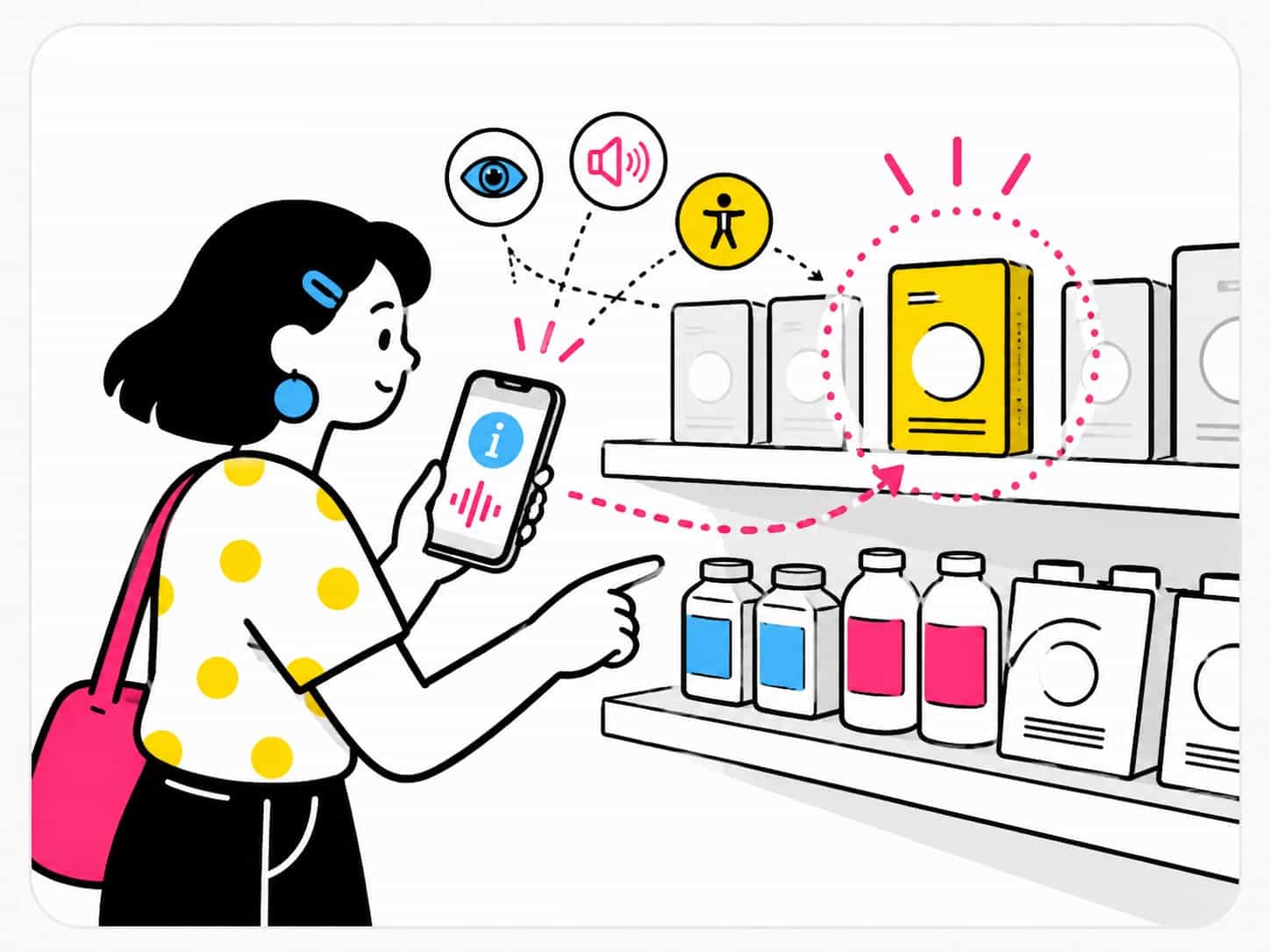
An accessible code in the package leaflet and/or labeling allows users to hear essential information—active substance, dose, contraindications, posology—in their own language, from several yards away and without the need to focus precisely. AEMPS's instruction does not oblige manufacturers to incorporate it, but for the first time sets out in detail how to do so should they choose.
NaviLens in the official document
The AEMPS text addresses two scenarios with their own procedures: the inclusion of a translation of the package leaflet into other languages, and the inclusion of NaviLens. It is the only technology named in the body of the instructions — something unusual in a regulatory text that typically avoids mentioning specific brands or suppliers.
The mention is not incidental. AEMPS sets out the administrative steps that a marketing authorisation holder must follow to incorporate the code into an already-marketed medicine, and clarifies the applicable type of variation. In practice, this removes one of the main regulatory uncertainties that had held manufacturers back regarding how to process the inclusion of an accessible code in the package leaflet and/or labeling.
European framework: the backing of the CMDh
AEMPS's instructions do not emerge from a vacuum. They are underpinned by a position paper published by the CMDh (Coordination Group for Mutual Recognition and Decentralised Procedures — Human), the European group that harmonizes criteria among national medicines agencies. This EU-level backing has a significant practical consequence: the approach adopted in Spain is consistent with the European procedures applicable in other EU Member States via mutual recognition or decentralised routes.
For a manufacturer with a European footprint, this reference provides a coherent basis for considering the extension of the solution through mutual-recognition or decentralised procedures. Nevertheless, each market, authorisation and presentation must be reviewed in accordance with the requirements of the competent authority and the applicable regulatory pathway.
What this means in practice for a manufacturer
Translated into regulatory affairs language, the new situation clarifies what until now was a decision clouded by too many variables. The steps a marketing authorisation holder may take following publication are, in summary:
- Review instruction MUH 05/2026 and confirm the applicable type of variation for the product in the portfolio.
- Define which content from the package leaflet and/or labeling will be linked to the code: minimum mandatory information, allergens, posology or the complete package leaflet (and, where applicable, directing the user to the summary of product characteristics).
- Prepare the package leaflet and/or labeling mock-ups with the code in a fixed, verified position, maintaining the legibility of all other regulatory elements.
- Submit the notification or variation in accordance with the procedure indicated by AEMPS, enclosing the required technical documentation.
- Plan industrial implementation on the packaging line and coordinate the loading of the associated content in the user's language.
- Where applicable, assess extension to other EU markets via mutual-recognition or decentralised procedures.
The specific regulatory fit depends on the starting position and the impact on the approved mock-ups. Where the incorporation does not alter the regulated information or affect the legibility of the material, it may be processed by way of notification. Where it modifies the design or legibility of the mock-ups, a regulatory variation may be required. The final classification must be confirmed for each presentation and procedure.
Cinfa: the practical reference
The most mature example of NaviLens in pharmaceutical packaging in Spain is the rollout by Cinfa Laboratories, which has incorporated accessible codes across various presentations in its catalog. Cinfa's experience demonstrates that industrial implementation is feasible with conventional packaging lines and that the real work lies in content governance: what information is presented, in what order, and how it is updated throughout the product lifecycle.
The new AEMPS framework turns this pioneering experience into a reference that is extensible to the rest of the sector, with the added advantage of an explicit regulatory procedure now in place. If your company is considering taking the step—from a single pilot presentation to an entire portfolio—NaviLens is on hand to support you throughout the journey: write to us and we will explore it together.
What to expect in the coming months
The pharmaceutical sector moves on long regulatory cycles, and the effective incorporation of accessible codes into most presentations will not happen overnight. But the signal sent by AEMPS is clear: the accessibility of the package leaflet and labeling is no longer a voluntary exercise — it is becoming part of the ordinary vocabulary of Spanish pharmaceutical regulation.
NaviLens will continue to support manufacturers wishing to take the step, both on the technical side—code design, industrial integration, multilingual content—and in validation with real users, including blind individuals and those with low vision, who are ultimately the measure of whether the package leaflet and labeling truly work.
Official sources
- AEMPS information notice on instruction MUH 05/2026
- AEMPS instructions on QR codes and mobile-scanning technologies in package leaflet and labeling (full document, PDF)
- CMDh · Position paper on QR codes and mobile-scanning technologies (HMA/CMDh)
- EMA · Guidance on QR codes in product information for centrally authorised medicines (PDF)
Frequently asked questions
- Does the AEMPS instruction make NaviLens mandatory on all medicines?
- No. Instruction MUH 05/2026 does not impose the inclusion of accessible codes; rather, it regulates the procedure by which a marketing authorisation holder may incorporate them—should it so decide—in the package leaflet and/or labeling of an authorised medicine.
- Does it also apply to medicines authorised in other EU countries?
- Not automatically. AEMPS's instruction is underpinned by the CMDh's European framework and provides a coherent basis for mutual-recognition and decentralised procedures. However, the specific application must be reviewed according to the country, the authorisation and the regulatory pathway for each medicine.
- What is the difference between a standard QR code and NaviLens on a medicine pack?
- A standard QR code requires the user to locate the code visually and frame it with the camera. NaviLens is detected from several yards away, without the need for precise focus, and reads the content aloud in the user's language, making it independently usable by blind individuals or those with low vision.
- Does the code replace the paper package leaflet?
- No. AEMPS's instruction regulates the use of the code as a complement to the package leaflet and/or labeling, not as a replacement for the paper package leaflet or any other mandatory information.
- Where can I consult the official text?
- The information notice and the link to the document are published on the AEMPS website: consult the official notice on aemps.gob.es.