European Accessibility Act 2025: a complete guide for businesses
What the EAA requires from June 2025, who it affects, and how to prepare a realistic compliance plan in transport, retail, banking and digital services.

The European Accessibility Act (EAA, Directive 2019/882) is the EU regulation that harmonizes accessibility requirements for products and services across the 27 Member States. It has been mandatory since 28 June 2025, after six years of national transposition.
Its goal is to remove the divergence between national laws that has fragmented the internal market for decades and left out more than 87 million people with disabilities living in the European Union, according to European Commission data.
Who it applies to
The EAA affects manufacturers, importers, distributors and service providers operating in the EU. It covers both large corporations and SMEs that market products or services within its scope, regardless of where they are headquartered. Companies based outside the EU that sell into the single market are equally bound.
- Consumer computing equipment and operating systems
- ATMs, payment terminals, ticketing and check-in machines
- Electronic communications services, including 112 emergency communications
- E-commerce services (B2C)
- Passenger transport: information, ticketing, terminals and web/app services
- Consumer banking services (online banking, authentication, contracts)
- E-books, reading software and distribution platforms
- Audiovisual services: access to programs, EPG and players
What it requires in practice
The EAA introduces a clear principle: information must be perceivable, operable, understandable and robust — the four POUR principles inherited from WCAG. In the physical world this translates into multi-sensory signage; in digital, into compliance with WCAG 2.1 level AA as a minimum, aligned with the harmonized standard EN 301 549.
The most important novelty is that, for the first time, a European law treats accessibility as a market requirement: a non-accessible product or service cannot legally be placed on the market. Presumption of conformity is achieved by applying the harmonized standards; any alternative requires documented equivalence.
A 5-step compliance plan
1. Accessibility audit
Map every customer touchpoint: web, app, physical spaces, packaging, customer service, contractual materials. Identify gaps against WCAG 2.1 AA and EN 301 549. Combine automated tools (axe, WAVE, Lighthouse) with manual auditing and, above all, real user testing: no tool detects more than 30-40% of barriers.
2. Prioritised roadmap
Prioritise by impact and volume. Checkout pages, station entrances, customer-facing service points and authentication flows are usually quick wins. Apply the 80/20 rule: 20% of journeys concentrate 80% of critical traffic.
3. Technology solutions
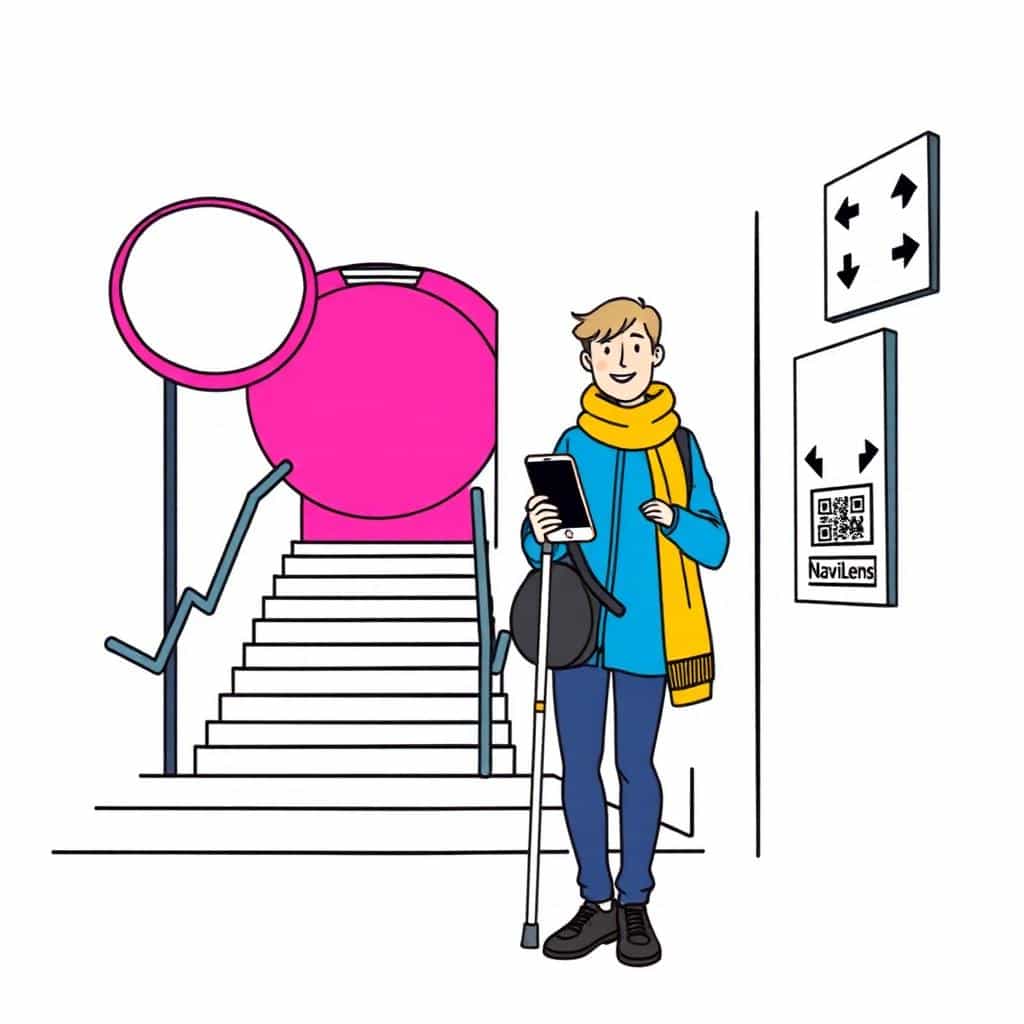
Where traditional signage falls short, deploy accessible digital layers: NaviLens codes can be read from up to 100 feet, in 42 languages and without contact, without replacing existing infrastructure. In digital, prioritise well-implemented ARIA components, full keyboard navigation and minimum 4.5:1 contrast.
4. Team training
Compliance is not only technical. Designers, copywriters, developers and store staff need to understand the principles of universal accessibility. Companies with ongoing training programs cut accessible maintenance costs by 60%, according to a Deque study (2024).
5. Documentation and continuous improvement
Keep a record of conformity assessments, public accessibility statements per service and an update plan. The EAA requires traceability and periodic reviews, aligned with the continuous improvement principle of ISO 9001.
Exceptions and disproportionate burden
The directive allows companies to invoke disproportionate burden when adaptation costs are unaffordable, but requires the assessment to be documented with objective criteria: size of the organization, available resources, expected benefit for people with disabilities. It is not an escape route: national authorities can review it.
"Accessibility is not a compliance cost: it is a growth channel that opens your product to 15% of the population."
Frequently asked questions
- What happens if I don't comply with the EAA?
- Each Member State defines sanctions. In Spain, Law 11/2023 provides for fines of up to one million euros for very serious infringements, in addition to the possible withdrawal of the product from the market.
- Does it apply to micro-enterprises?
- Micro-enterprises (fewer than 10 employees and turnover below €2M) are exempt from the requirements for services, but not for products. In any case, they must notify the authorities when relying on the exemption.
- How does it relate to WCAG?
- The EAA is based on the harmonized standard EN 301 549, which in turn integrates WCAG 2.1 AA for digital content. Complying with WCAG 2.1 AA is necessary—but not sufficient—for digital conformity.