Case study · 14 St-Union Square, NYC
Eight lines. One station.
And a code that talks to you.
Lines 4 5 6 N Q R W L converge at 14 St-Union Square. The MTA has added NaviLens codes next to the turnstiles so that blind, low-vision and non-English-reading travelers know—by voice and in their own language—exactly which train is on the other side.
8
Lines in a single station: 4 5 6 N Q R W L
Top-5
Busiest stations in the NYC subway
42
Languages the app reads the information in
$2M
US DOT SMART Grant to expand NaviLens across the MTA
The client
MTA · New York City Transit
14 St-Union Square
The Metropolitan Transportation Authority runs the New York subway: the largest public transit network in the United States. After the Jay Street-MetroTech “lab”, NYC Transit has rolled NaviLens out to dozens of stations across Manhattan and the Bronx.
14 St-Union Square is one of those nodes: a subterranean complex where the Lexington Av line (4 5 6), the BMT Broadway (N Q R W) and the 14th St-Canarsie (L) share platforms, mezzanines and historic mosaics. Static information is no longer enough here: it has to be heard.
§ The challenge
Make picking the right turnstile not a blind bet.
- 01
An octopus-station in the middle of Manhattan
14 St-Union Square is one of the great transfer nodes of the NYC subway: lines 4, 5 and 6 meet N, Q, R, W and L in a maze of corridors, mezzanines and exits to Park Avenue South, Broadway and University Place.
- 02
A critical decision at every turnstile
Each turnstile bank leads to a different set of lines (4-5-6 on one side, N-Q-R-W-L on the other). Anyone who can't see the overhead sign risks boarding the wrong train or having to exit and re-enter.
- 03
The most multilingual subway in the world
Union Square is crossed every day by people speaking dozens of languages. Static signage, in English and sometimes Spanish, leaves out a large share of travelers—tourist or resident—who can't read it.
§ The solution
One code per turnstile bank.
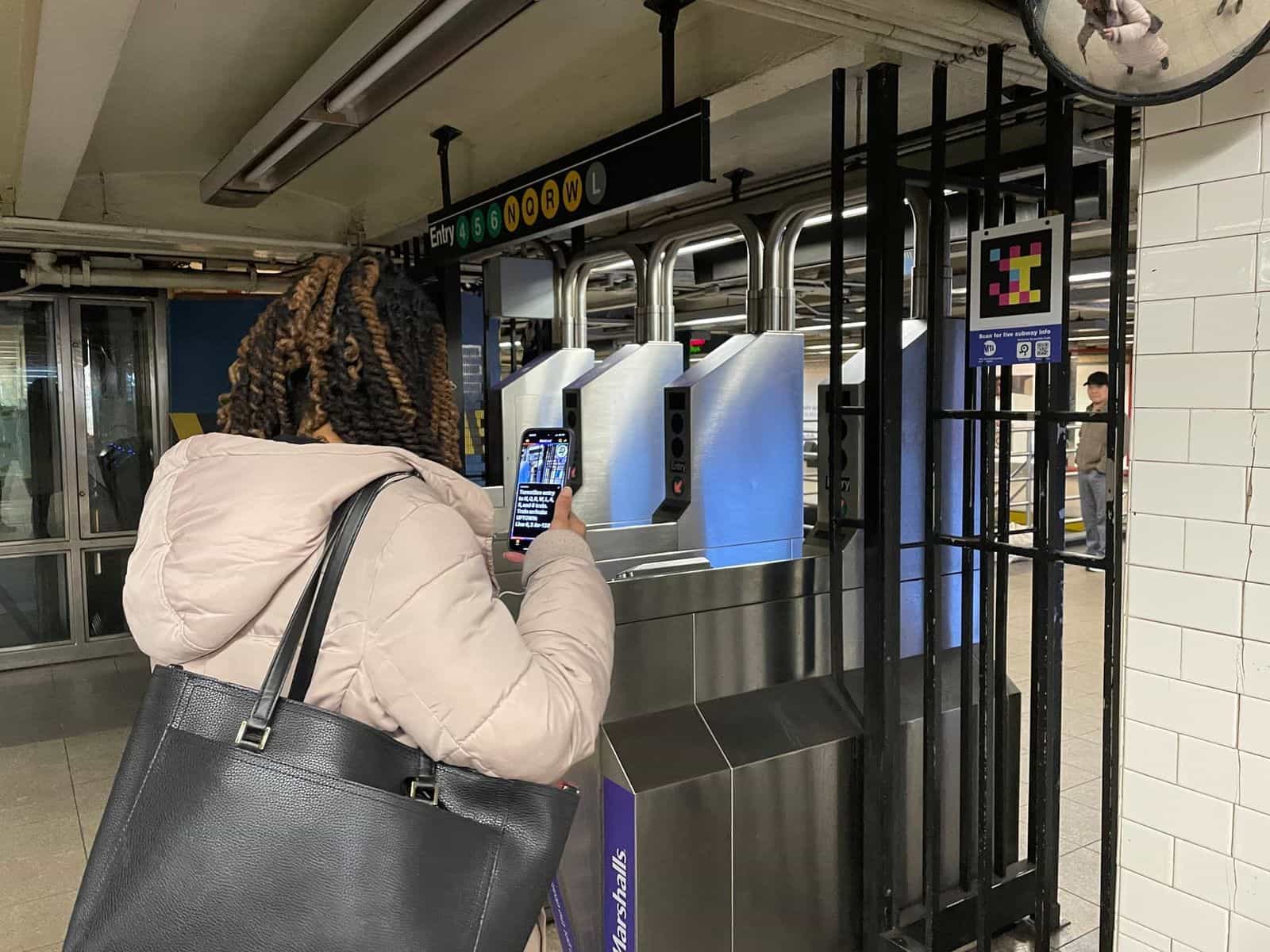
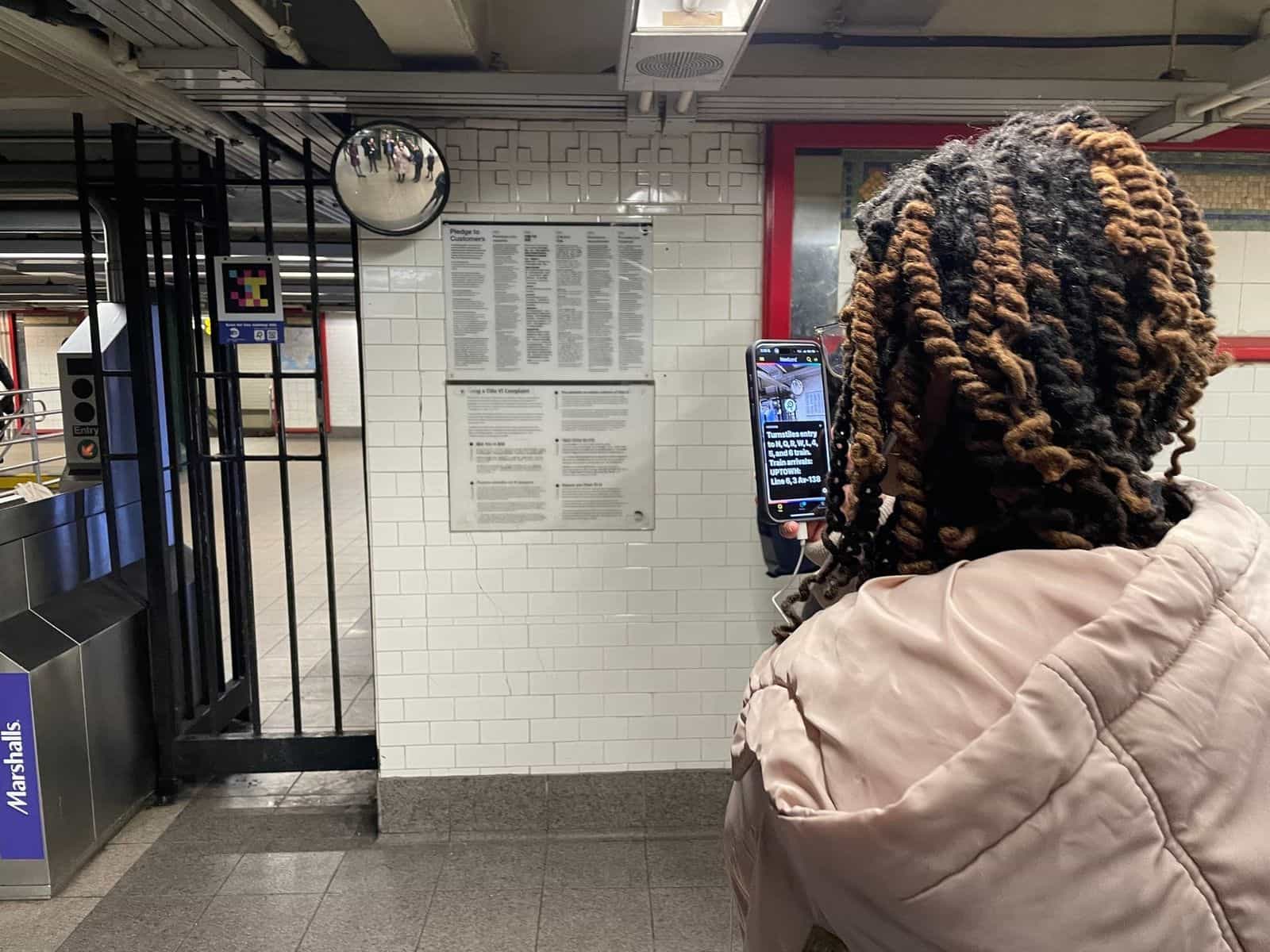
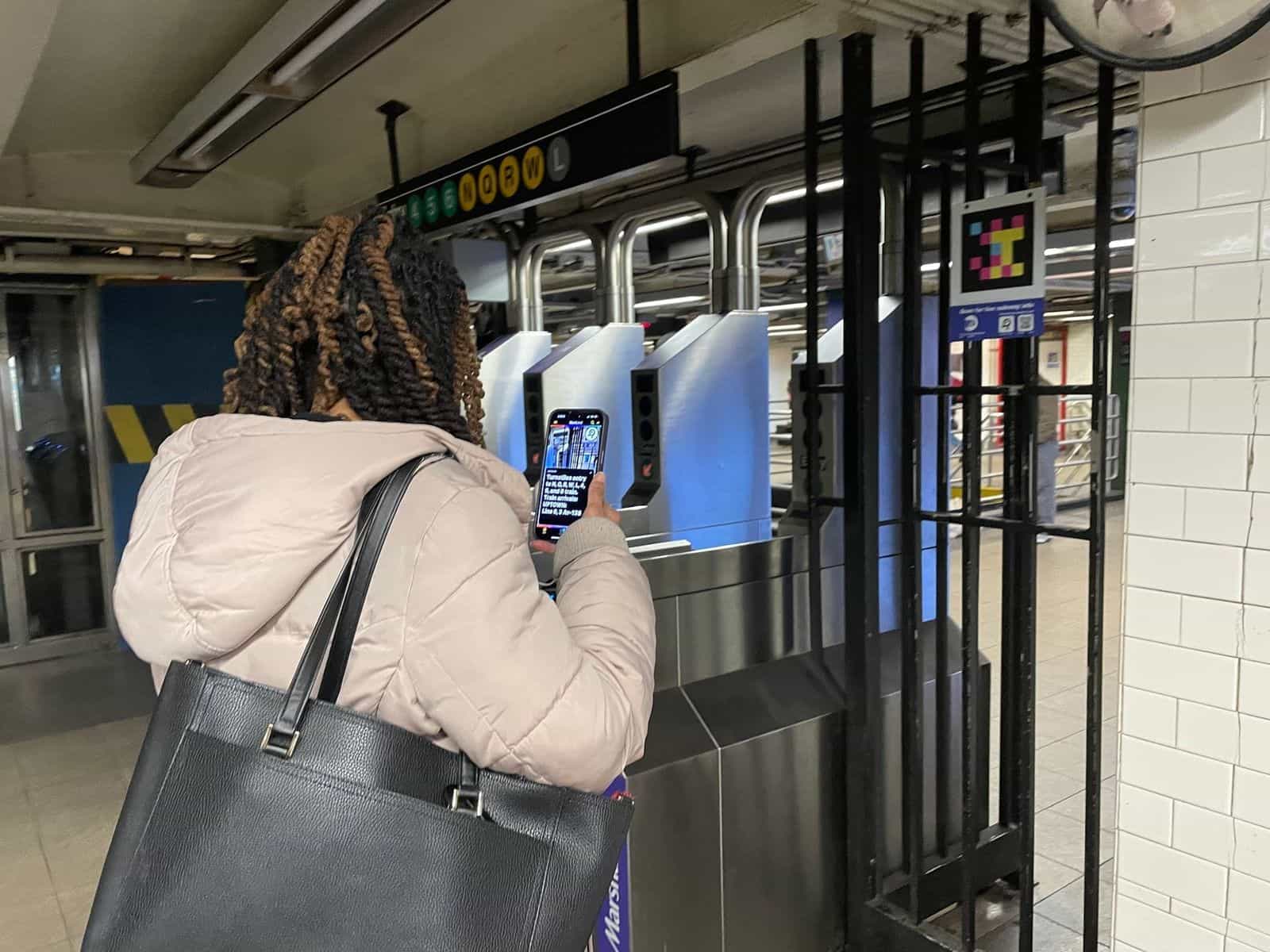
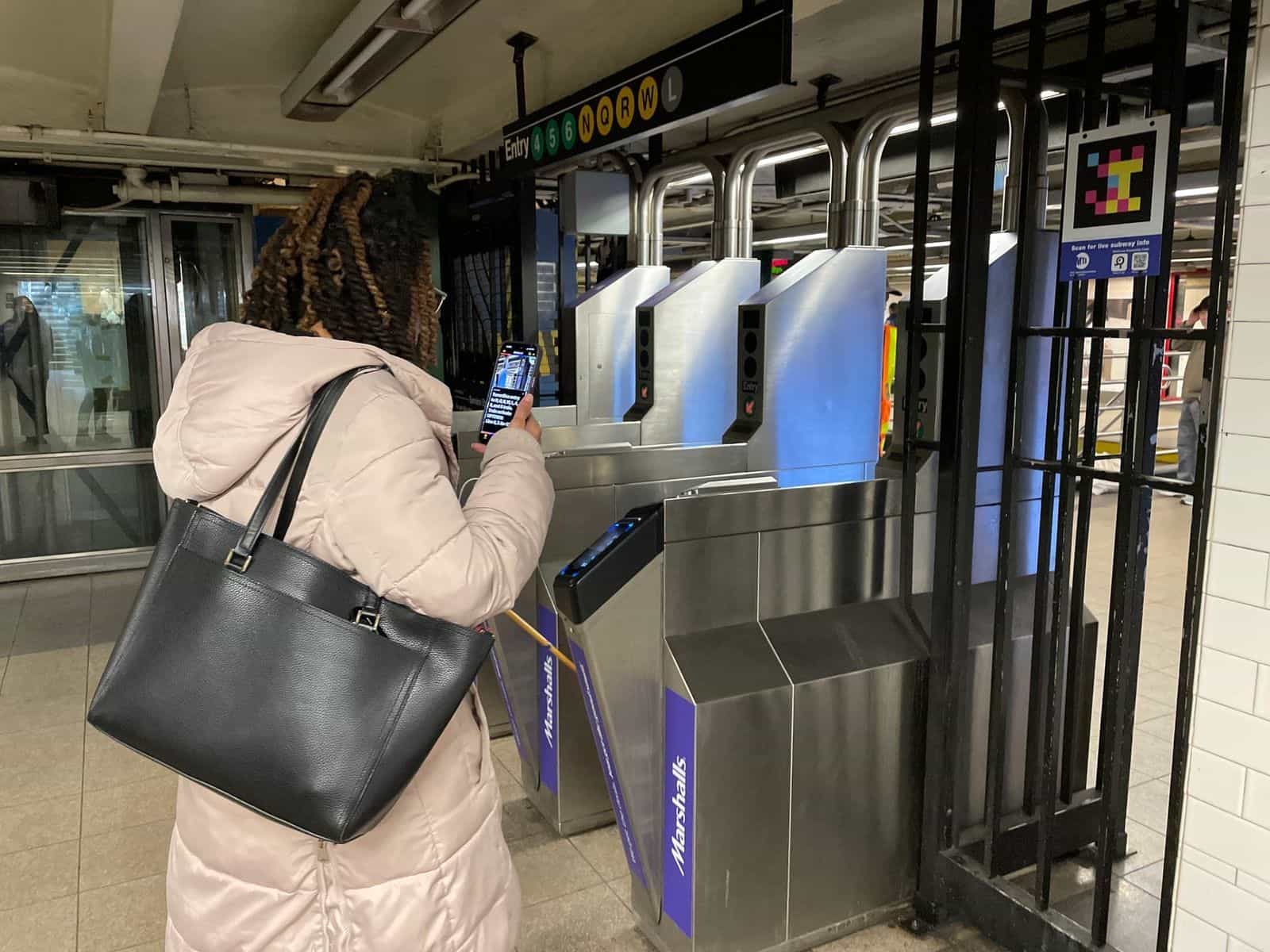
Every turnstile bank has a NaviLens code mounted high above. The app detects it from several yards away, without focusing, and announces aloud which turnstile that is and which lines are on the other side.
The on-screen audio leaves no doubt: “Turnstiles entry to N, Q, R, W, L, 4, 5 and 6 train. Train arrivals: UPTOWN: Line 6, 3 Av-138…” — wayfinding and next trains in a single readout, in the phone's language.
§ Rollout
Codes at the concourse's decision points.
§ On the ground
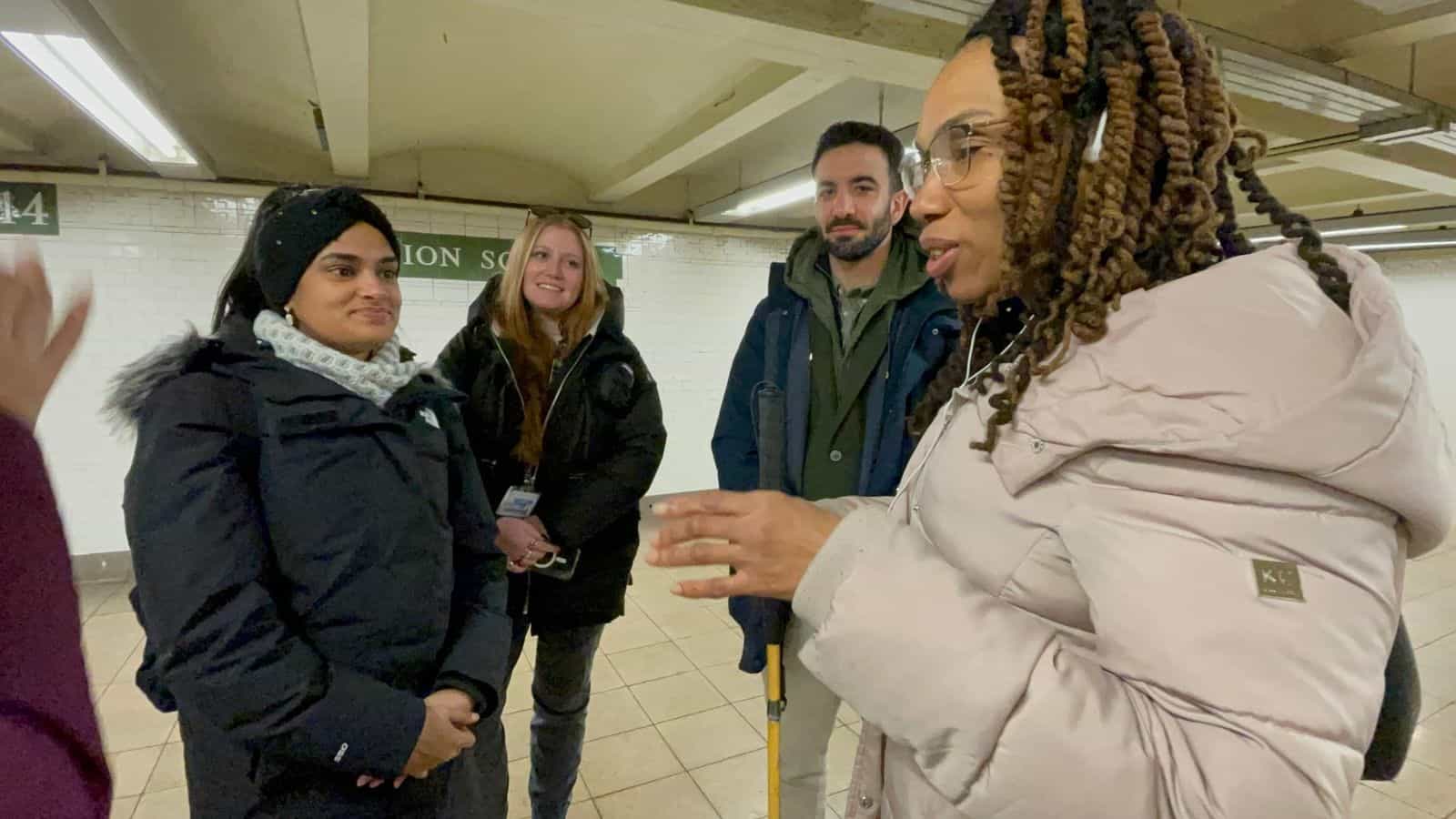
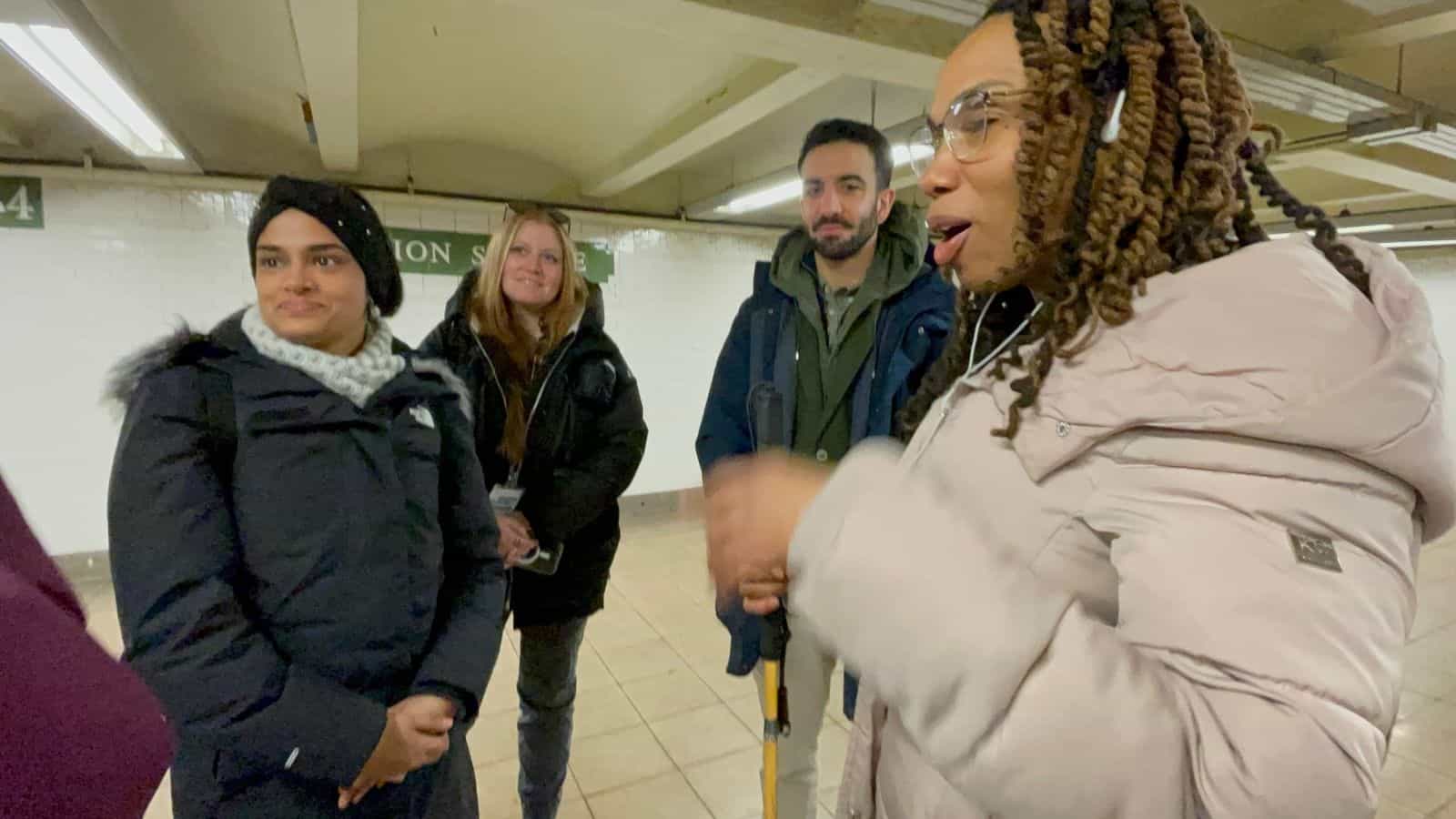
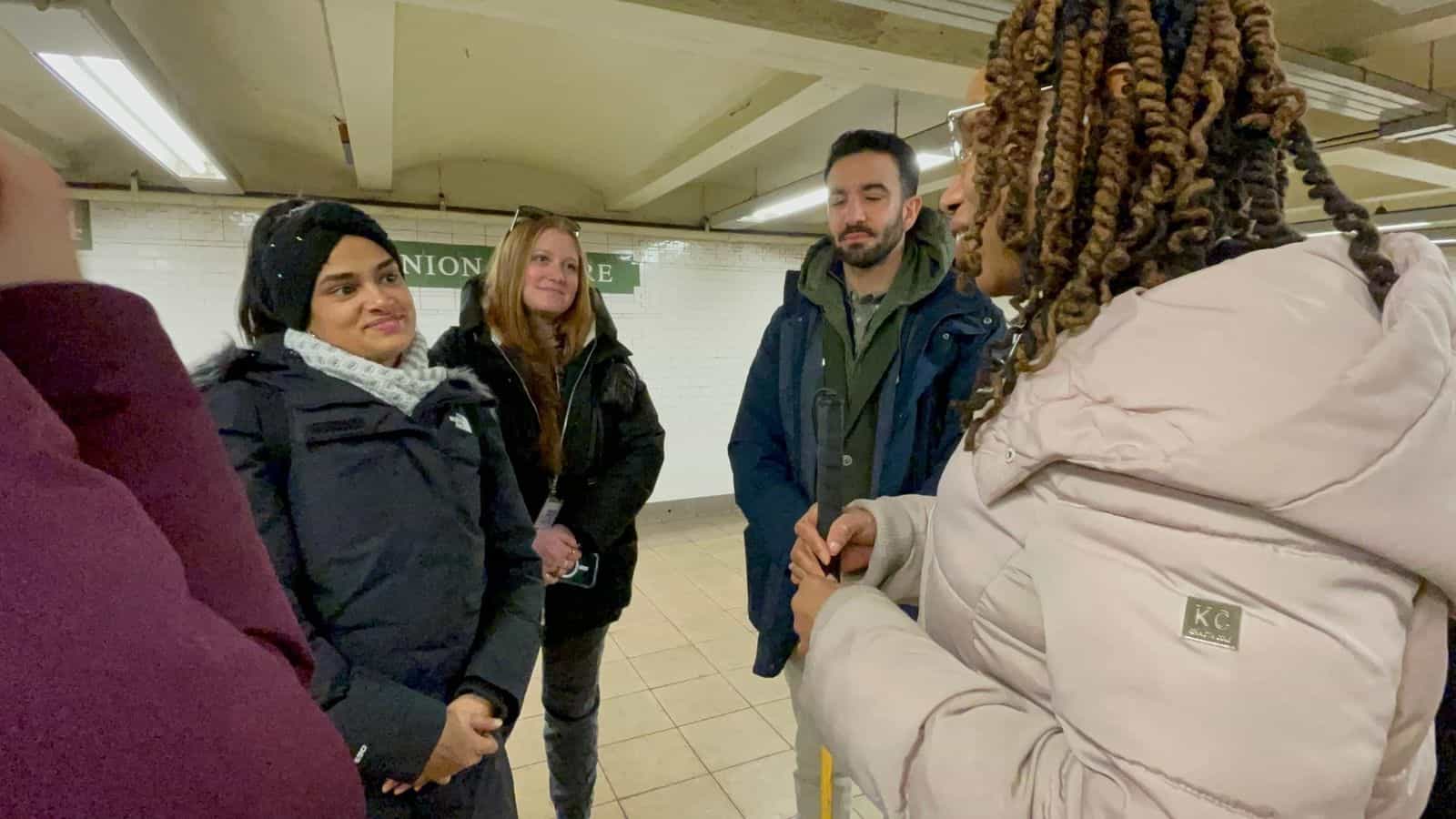
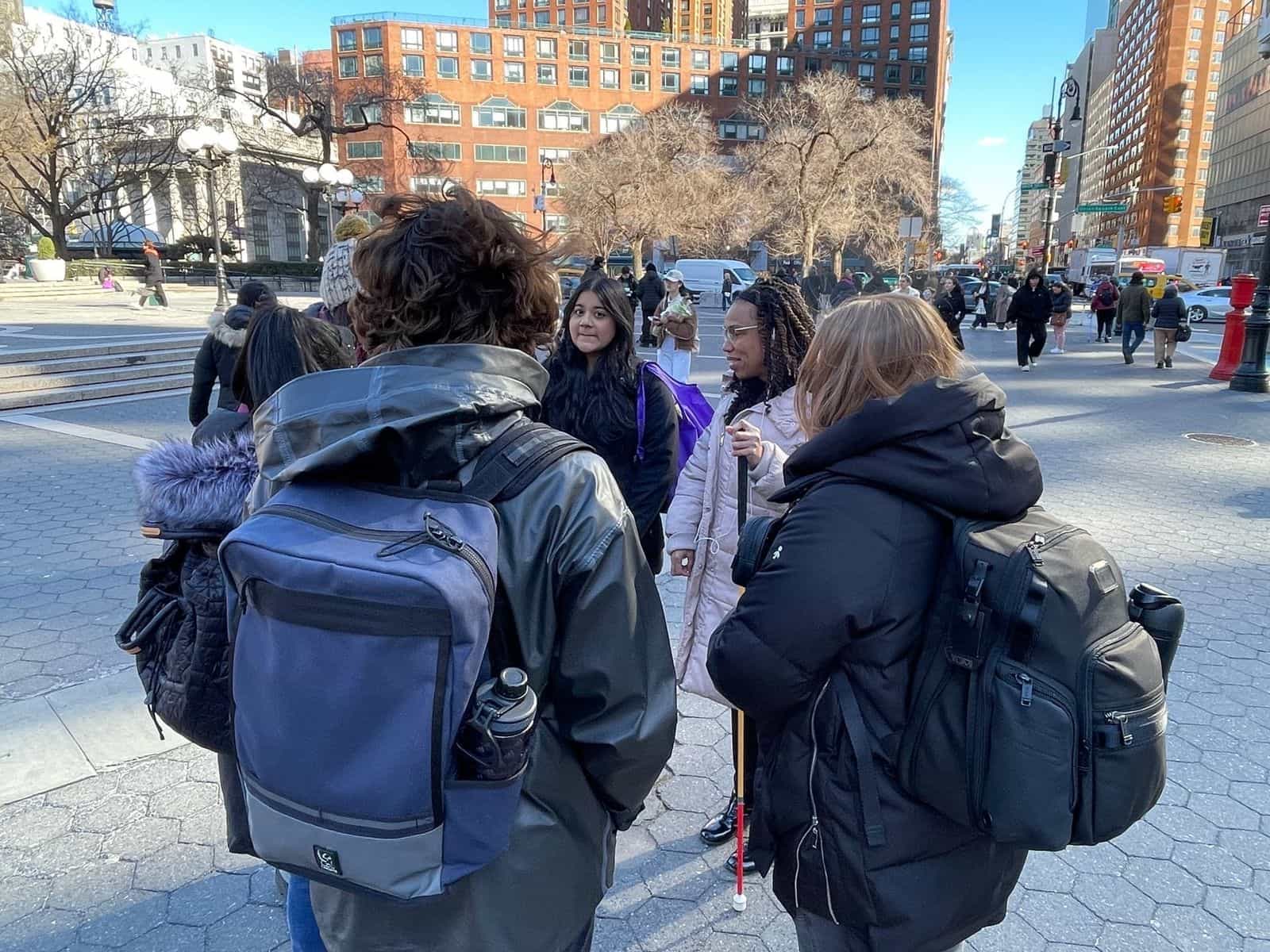
Tested by real users on the platform.
§ Timeline
From Jay Street to half the Manhattan grid.
- Jul 2023
Disability Pride Month: MTA announces the expansion
The MTA presents the plan to expand NaviLens beyond the Jay Street-MetroTech Accessible Station Lab, with funding secured by State Senator Brad Hoylman-Sigal and Senator Brian Kavanagh to take accessible wayfinding to more stations.
- Jan 2024
Rollout on lines 1, 2, 3 and the M66 bus
NaviLens codes appear at Upper West Side stations and along several Manhattan lines, with a stated plan to add nine more stations before March. Local press (West Side Rag, CBS NY, Time Out) explains the why behind the color squares.
- 2024
US DOT SMART Grant: 2 million dollars
The MTA receives $2M from the US DOT SMART Grant program to expand NaviLens to all six stations of line 6, to the line-6 trains and to the M23-SBS, M66 and Bx12-SBS bus stops and buses.
- Today
Union Square, in the NaviLens grid
14 St-Union Square (456 + LNQRW) is on the official list of MTA stations with NaviLens, alongside other Manhattan nodes such as Brooklyn Bridge-City Hall, 59 St-Columbus Circle, 14 St-8 Av or 125 St — all stitched together by the same voice wayfinding system.
§ What they said
What the MTA and the NY press said.
“It speaks to the customer — low vision and blind customers who are using the code to help get wayfinding navigation, both on the sidewalks to find the bus stop or an entrance to the subway and throughout the subway system to navigate those stations.”
“Designed to deliver independence to our low vision and blind New Yorkers and visitors so they can move around on their own time. For customers who aren't able to read in English, it really unlocks access for all of our customers.”
“Through the SMART Grant, NaviLens is rolling out at all 6 subway stations, on all 6 line subway cars, and on all M23-SBS, M66 and Bx12-SBS bus stops and buses.”
§ Results
Voice wayfinding, in the traveler's language, in one of the densest nodes on the planet.
100 ft
Codes detected without focusing and on the move
Voice + AR
NaviLens app (blind / low vision) and NaviLens GO (everyone else)
42 languages
Audio comes out in the language of the traveler's phone
§ And your network?
Your next station can also speak.
Tell us about your network, your pain points and the KPIs you want to move. We’ll show you how NaviLens would fit—with comparable cases.