DOJ Title II web rule: which deadline is yours, and the duty it doesn't cover
April 2026 or April 2027? The trigger is the population served, not the size of your agency — and special districts get the later date. Plus the older obligation the same audit always surfaces.

Ask ten transit agencies when their Title II web deadline falls and you will get two answers, both stated with confidence, and most of them wrong. The Department of Justice published its rule on the accessibility of web content and mobile apps for state and local governments in April 2024. It set two compliance dates. Which one applies to you does not depend on how big your agency is, and that is where the confusion starts.
This guide separates three things that get mixed together in almost every vendor deck: what the rule actually covers, which date is yours, and the older duty the rule leaves completely untouched — the one that shows up in the same audit and that no website fix will close.
1. What the rule covers, and what it does not
The rule sits at 28 CFR Part 35, Subpart H. It adopts WCAG 2.1 Level AA as the technical standard, and it applies to two things: the web content a public entity provides or makes available, and the mobile apps it provides or makes available. That includes content a contractor publishes on your behalf.
It does not cover your printed signage. It does not cover the information posted at a stop, on a platform, or inside a vehicle. A station can be fully WCAG 2.1 AA on the website and still leave a blind rider with no way to know which bay they are standing at.
2. Which deadline is yours
The trigger is the total population of the public entity, not the size of its budget, its headcount or its ridership. And there is a second criterion that catches a lot of transit authorities off guard.
- April 24, 2026 — public entities with a total population of 50,000 or more.
- April 26, 2027 — public entities with a total population under 50,000, and special district governments regardless of population.
That second line is the one worth reading twice. A large share of transit authorities in the United States are constituted as special district governments, which means the later date applies to them even when they serve a metropolitan area of millions. If nobody on your team has checked how your agency is legally constituted, that is the first thing to establish — before you scope any remediation work.
The reverse trap is just as common. A city department that runs transit as one of its services is not a special district; it inherits the city's population figure and, in most metros, the 2026 date.
3. The exceptions, and why they are narrower than they sound
The rule carves out several categories. They are genuine, but each is tightly drawn, and reading them as a general escape hatch is a reliable way to fail an audit.
- Archived web content, kept for reference and not altered since being archived.
- Preexisting conventional electronic documents, unless they are currently used to apply for, access or participate in a service.
- Content posted by third parties that the entity neither provides nor makes available.
- Individualized documents that are password-protected.
- Preexisting social media posts.
Note the second one. A PDF schedule from 2019 sitting in an archive is one thing; the same PDF still being the way riders find out when the bus comes is a document currently used to access a service, and it is in scope. Most agencies have more of the second kind than they think.
4. The duty the web rule does not touch
Here is what makes the next eighteen months genuinely useful rather than merely expensive. To scope the web work, you have to inventory how riders actually get information. That inventory almost always surfaces a gap that predates the 2024 rule by decades.
Under 28 CFR 35.160, a public entity must take appropriate steps to ensure that communication with people with disabilities is as effective as communication with everyone else, furnishing auxiliary aids and services where needed, and giving primary consideration to what the individual requests. That duty has been in force since the ADA's implementing regulations. It is not satisfied by a compliant website.
The Department of Transportation's rules add operational specifics for transit: 49 CFR Part 37 governs the provision of transportation services, including announcing stops and identifying routes to riders who need it, and 49 CFR Part 38 sets accessibility specifications for vehicles. These are the obligations that live at the stop and inside the vehicle, exactly where a website cannot reach.
So the honest sequence is: the web rule sets the clock, the audit finds the physical information gap, and closing that gap is a separate piece of work answering to a separate rule.
5. What to do inside the window
- Establish how your agency is legally constituted, and therefore which date binds you. Put the answer in writing.
- Inventory rider-facing information by channel — website, app, printed schedules, stop signage, in-vehicle announcements — not by department. The gaps live between departments.
- Separate the WCAG 2.1 AA remediation backlog from the effective-communication backlog. They have different owners, different budgets and different rules behind them.
- Ask every vendor for an accessibility conformance report. In federally funded procurement it will be requested anyway, and a vendor who cannot produce one is telling you something.
- Check whether the physical work is fundable. Section 5310 and USDOT discretionary programs have supported accessibility deployments, and grant calendars are slower than remediation calendars.
6. Where an accessible information layer fits
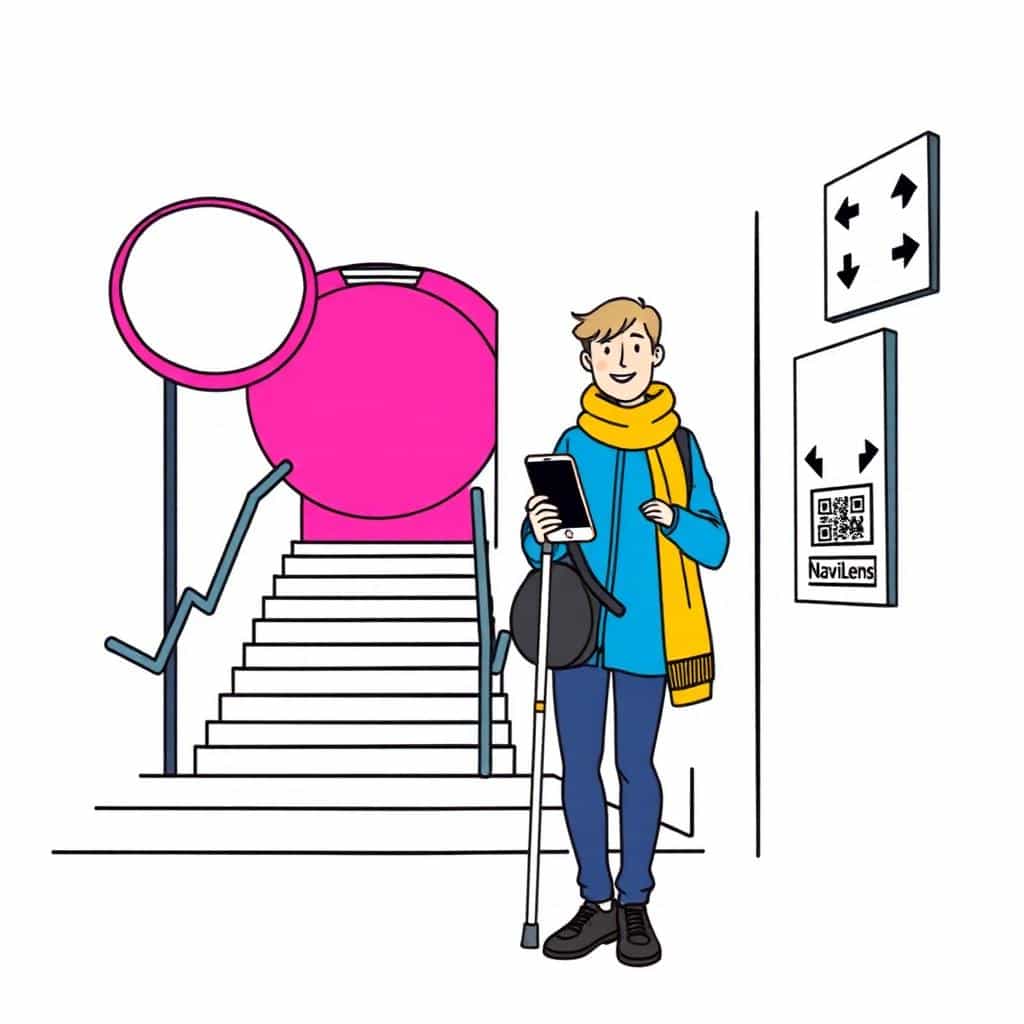
NaviLens is an auxiliary aid for effective communication. Printed markers at entrances, on platforms, at stops and inside vehicles are detected by the rider's own phone from a distance and without aiming, and the information is read aloud through the screen reader they already use, in their own language. No power, no wiring, no construction.
What that does not do is make you compliant with anything. It closes one specific gap — riders who cannot read printed signage getting the same information as everyone else — and it produces usage evidence you can cite when you document how you are meeting the effective-communication duty.
In the United States it is running at the MTA in New York, where a pilot at Jay Street–MetroTech grew into a deployment across dozens of subway stations and bus stops funded by a USDOT SMART grant, and at NJ TRANSIT, MBTA, CapMetro in Austin and VIA in San Antonio. Those agencies are the useful reference points, because they have already had the conversation you are about to have.
Frequently asked questions
- Is my transit agency subject to the April 2026 or the April 2027 date?
- It depends on how your agency is legally constituted and the total population it covers. Public entities with a population of 50,000 or more fall under April 24, 2026. Public entities under 50,000, and special district governments regardless of population, fall under April 26, 2027. Many transit authorities are special districts, so the later date applies more often than teams assume. Confirm your legal status before scoping work.
- Does the DOJ rule cover signage in stations and at stops?
- No. The rule applies to web content and mobile apps and adopts WCAG 2.1 Level AA for them. Physical signage is governed elsewhere — principally the effective-communication requirement at 28 CFR 35.160 and, for transit specifically, the Department of Transportation's rules at 49 CFR Parts 37 and 38.
- Can any product make us ADA compliant?
- No. Under the ADA the obligation sits with the covered entity, not with a vendor. A product can serve as an auxiliary aid and can generate evidence you cite in your own documentation, but the duty and the liability remain yours. Be skeptical of any supplier who says otherwise.
- What documentation should we ask vendors for?
- An accessibility conformance report based on the VPAT format, covering the software your staff and riders will actually use. In procurement funded with federal money it is reviewed against Section 508 and will be requested regardless, so it is better to ask early than to discover a gap at submission.
- Can we add an audible information layer without construction?
- Yes. Printed visual markers need no power, no wiring and no structural work. They are produced like any other signage and placed at the decision points riders already use — entrances, fare lines, platforms, bays and vehicle interiors.
- Are there federal funds for this kind of accessibility work?
- Accessibility deployments in transit have been supported through programs such as Section 5310 and USDOT discretionary grants; the MTA's NaviLens expansion was funded through a SMART grant. Eligibility and application windows vary by program and year, so check the current notice of funding opportunity rather than relying on precedent.