Case study · Blokhus · Museum
Paper can also be heard.
The Museum for Papirkunst, the only museum in the world dedicated to paper art, integrates NaviLens beside every label: work by Demaine, Nishimura, Mitani, Paul Jackson and other origami masters read aloud in 42 languages.
Blokhus
Museum for Papirkunst — Denmark
Whole room
Labels and plinths with NaviLens codes
Origami / Paper
Demaine, Nishimura, Mitani, Jackson…
42
Languages with voice reading
Client
Museum for Papirkunst
— Blokhus, Denmark
The Museum for Papirkunst, in the Danish coastal town of Blokhus (Jammerbugt, North Jutland), is the only museum in the world dedicated exclusively to paper art. Its collection brings together origami, cut paper, mathematical folding and paper sculpture by international figures.
With work by Erik & Martin Demaine, Alfonso Parra Rubio, Yuko Nishimura, Jun Mitani or Paul Jackson, the museum combines a permanent exhibition, an educational space (Origametria) and an audiovisual screening. NaviLens is built into the whole room as an accessible layer for international visitors and people with visual disabilities.
The integration is part of the group exhibition “Hands On Origami”, which the Museum for Papirkunst presents as the “first Danish cultural institution” to apply this accessible approach. The project is run with IBOS, Dansk Blindesamfund and the Danish Origami Federation, with specific workshops for blind and low-vision people.
§ The challenge
Letting every work tell its story.
- 01
Tiny labels, delicate works
Paper art requires minimal labels so as not to compete with the work: small type, labels at mid-height, info in Danish and sometimes English. For low-vision visitors, dyslexic readers or international tourists, reading every label broke the rhythm of the visit.
- 02
Works that demand context
A paper spiral by Erik & Martin Demaine, a STIR by Yuko Nishimura or the hands by Paul Jackson cannot be read without the story behind: technique, author, year, materials. With no interpretive guide, the work loses much of its meaning.
- 03
A bilingual museum in a tourist region
Blokhus, on the north coast of Jutland, welcomes Danish, German, Dutch, British and other international visitors. Printing labels in five languages was unworkable and still excluded everyone else.
§ The solution
One code beside every label.
Each work in the museum carries a discreet NaviLens code, on plinth or wall, beside the label. With the free NaviLens GO app the visitor points the phone and hears author, title, year, technique and dimensions in their language, from several yards away, without having to step closer to the print.
The exhibition design is left untouched: the codes are small, high-contrast squares that sit alongside white and yellow plinths without stealing focus from the work. The route is reinforced by the yellow line on the floor marking the safety distance.
§ Timeline
From the label to the voice.
- Origin
A unique museum dedicated to paper art
Museum for Papirkunst, in Blokhus, is the only museum in the world dedicated exclusively to paper art. It gathers work by international figures of origami and paper art—Erik and Martin Demaine, Alfonso Parra Rubio, Jun Mitani, Yuko Nishimura, Paul Jackson—in an intimate and carefully designed space.
- Rollout
NaviLens codes beside every label
The museum places a NaviLens code beside every label: on yellow and white plinths, next to wall panels and beneath every display case. The code is small, discreet and high-contrast—a “Tetris”-like colored square that coexists with the design without overtaking it.
- Today
A room that speaks 42 languages
The visitor points the phone and hears the work's data—author, title, year, technique, dimensions—in their language, from several yards away. The yellow floor line marks the safe route and the codes do the rest.
§ Walk-through
The works in the room.
Wall · Paul Jackson
Hand series — woven fragments
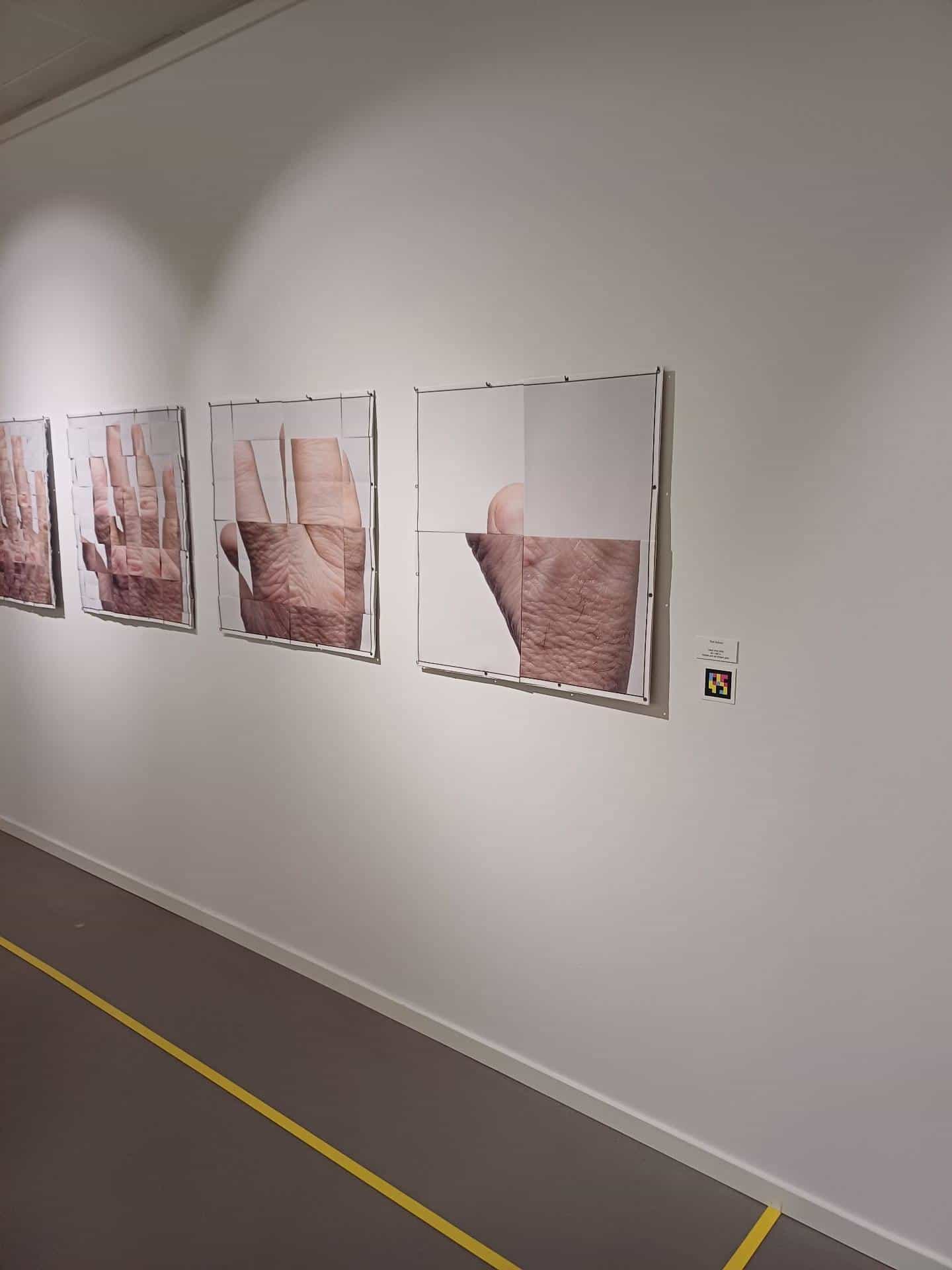
Paul Jackson's pieces—photographs of hands cut and interwoven on paper—come with a NaviLens code beside the label. The visitor hears author, title and series without stepping up to the printed text.
Yellow plinth · Demaine
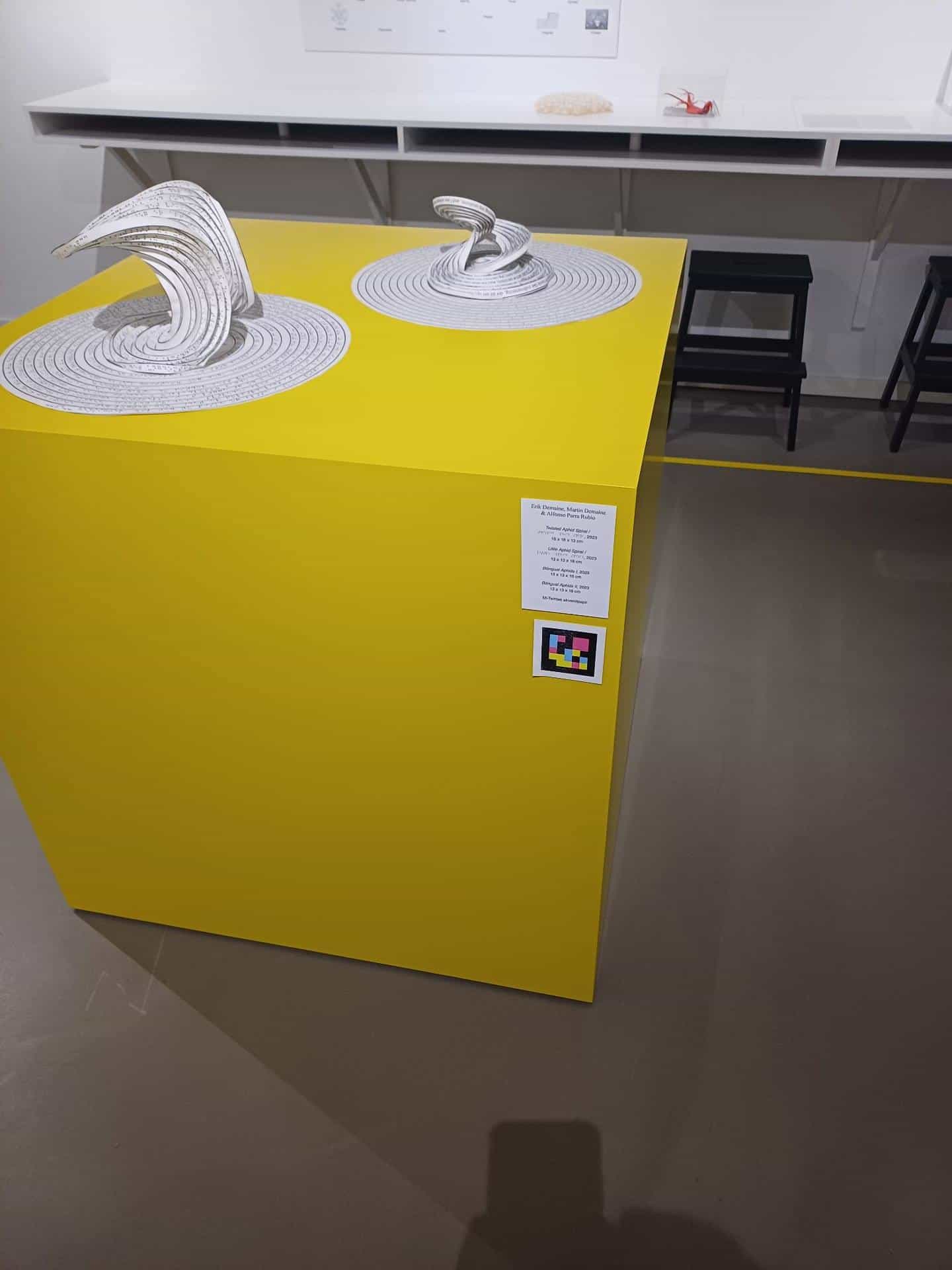
Twisted Aphid Spiral / Bilingual Aphids
On the yellow plinth, the paper spirals by Erik & Martin Demaine and Alfonso Parra Rubio are identified with a NaviLens code on the side face, reading title, dimensions (6×6×5 in) and materials—Mi-Teintes papier—in Danish, English, Spanish and 39 more languages.
White plinth · Demaine
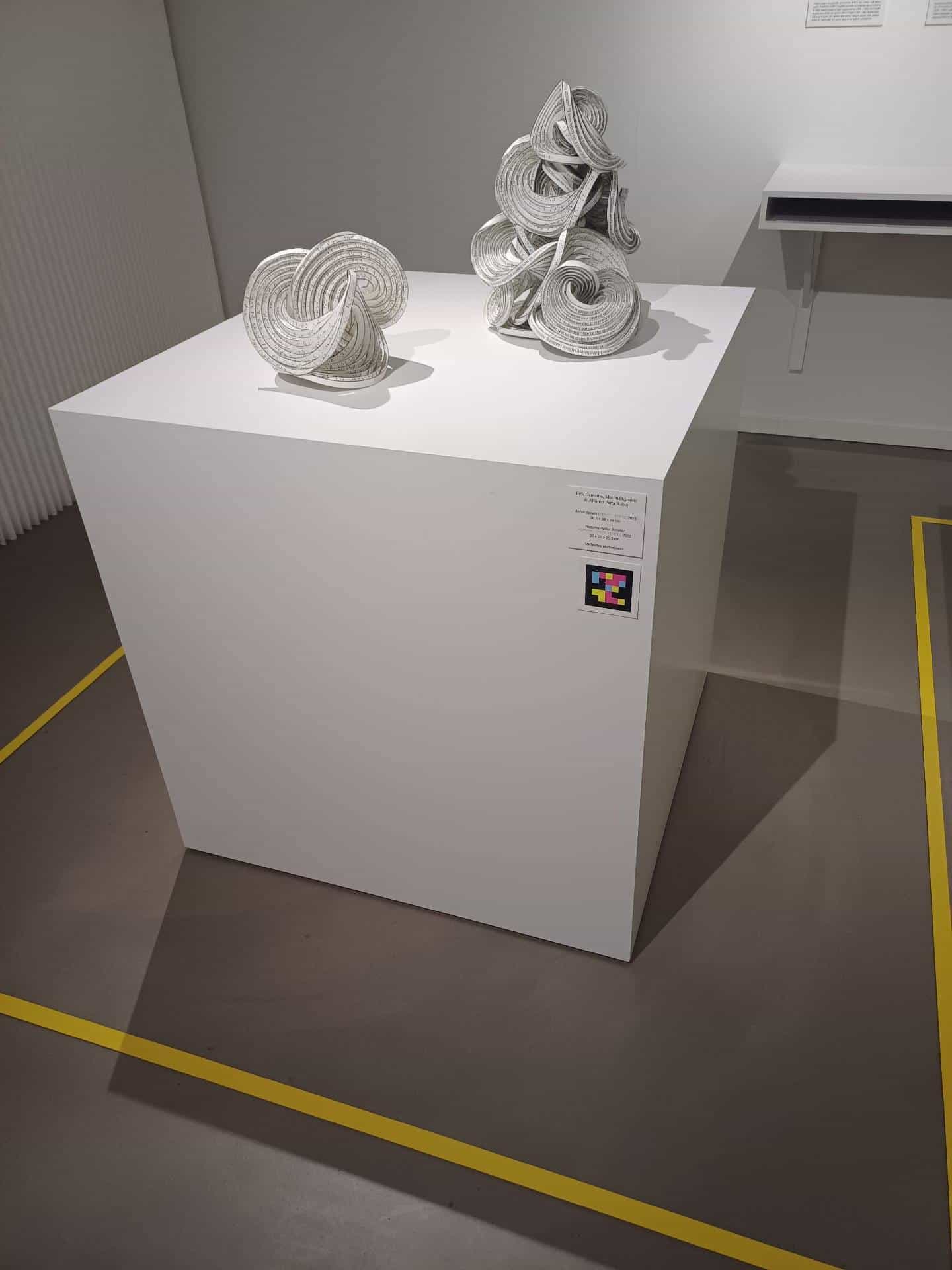
Aphid Spirals / Hugging Aphid Spirals
Demaine's curved-paper sculptures on the white plinth carry the NaviLens code in the lower corner. The yellow floor line marks the safety distance and the camera reads the code from outside the perimeter.
Wall · Yuko Nishimura
STIR4-50 — pleated relief
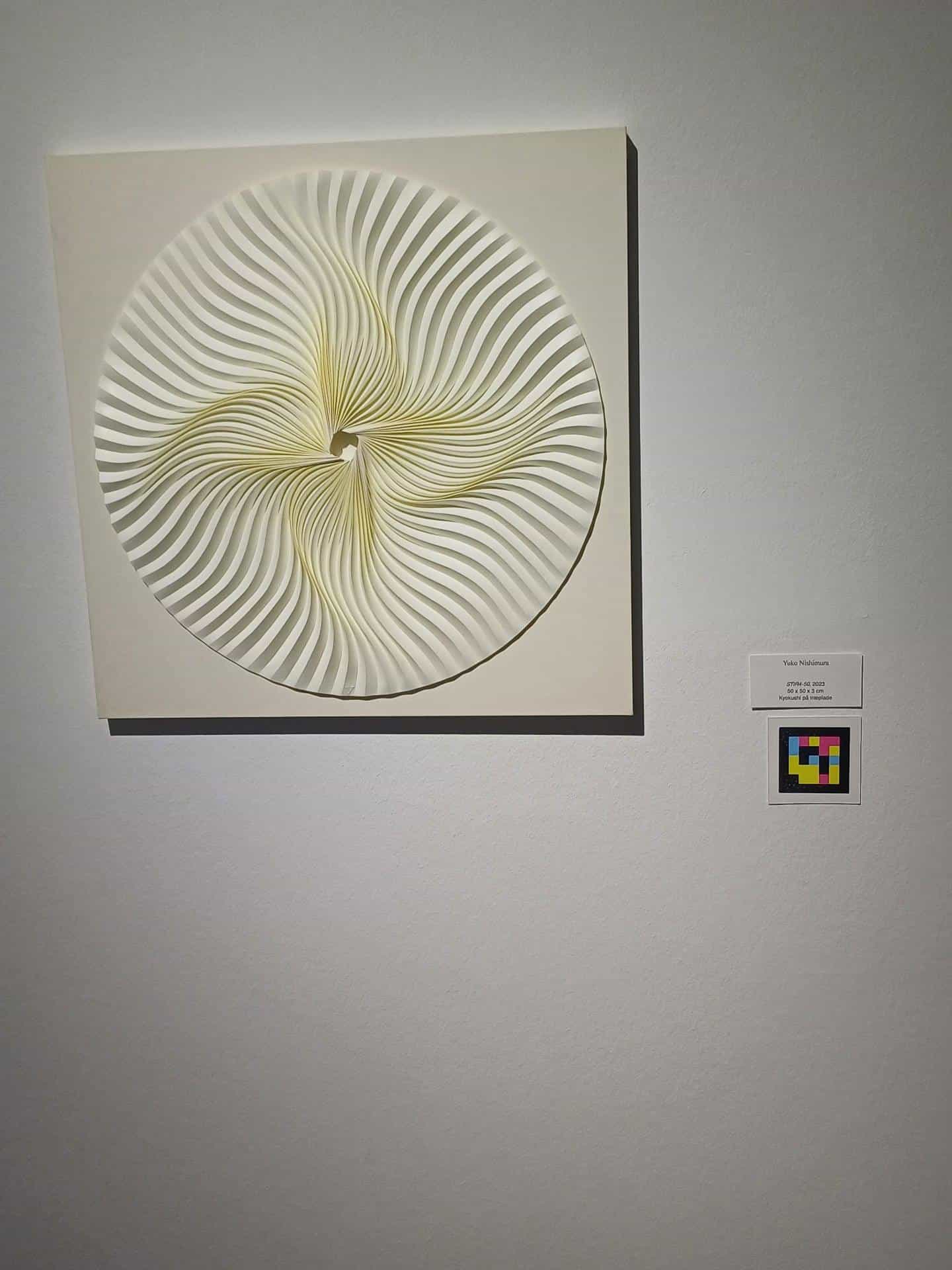
The pleated relief by Yuko Nishimura “STIR4-50” (20×20×1.2 in, kyokushi on board) comes with a NaviLens code beneath the label. The voice description explains the radial folding technique without distracting from the eyewear center of the piece.
Yellow plinth · Mitani
Jun Mitani — curvilinear origami
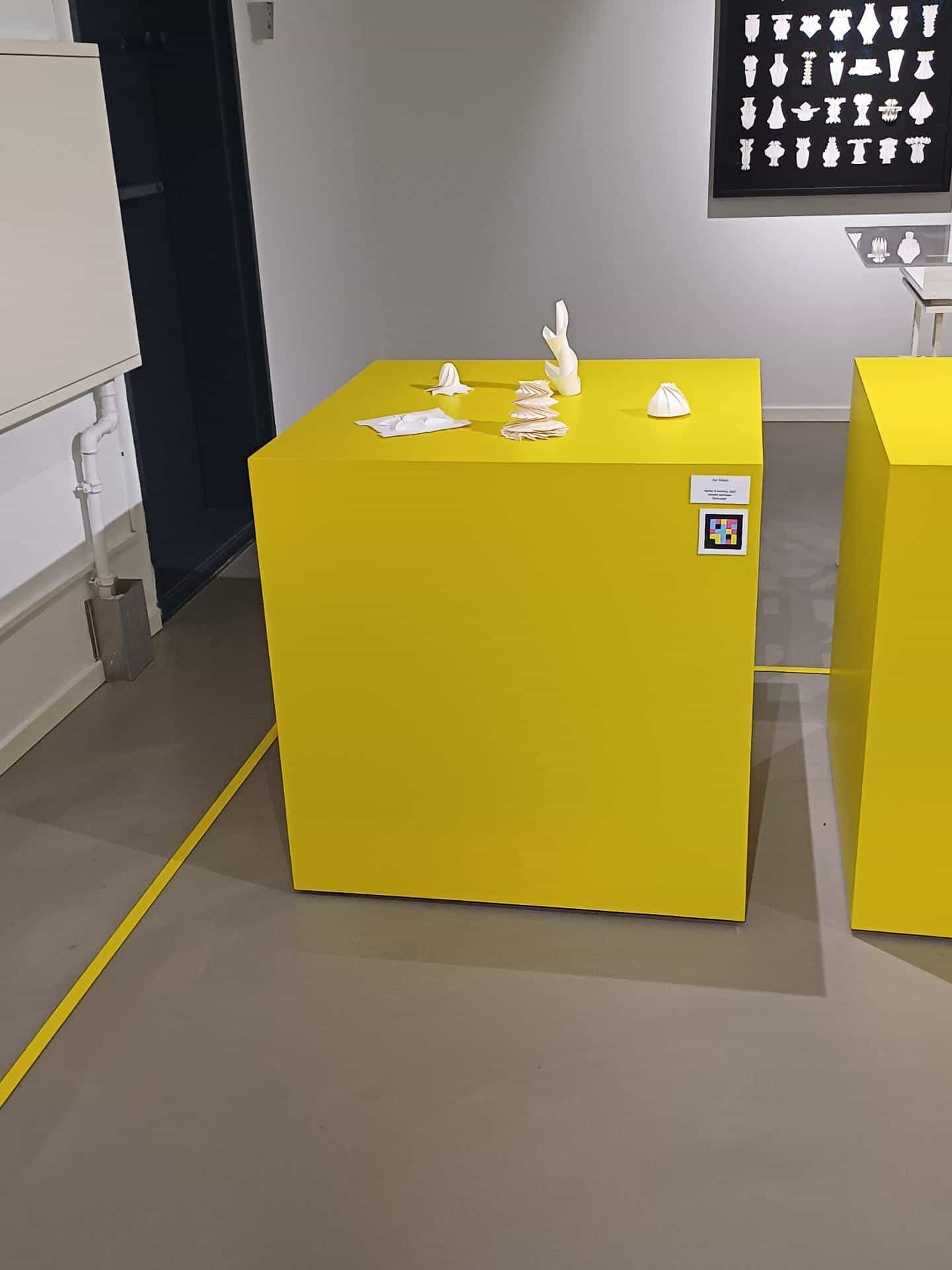
The selection of Jun Mitani's curvilinear origami, set on a yellow plinth, is identified with a single NaviLens code that opens the full record: author, computational technique, year and a short note on the folded geometry.
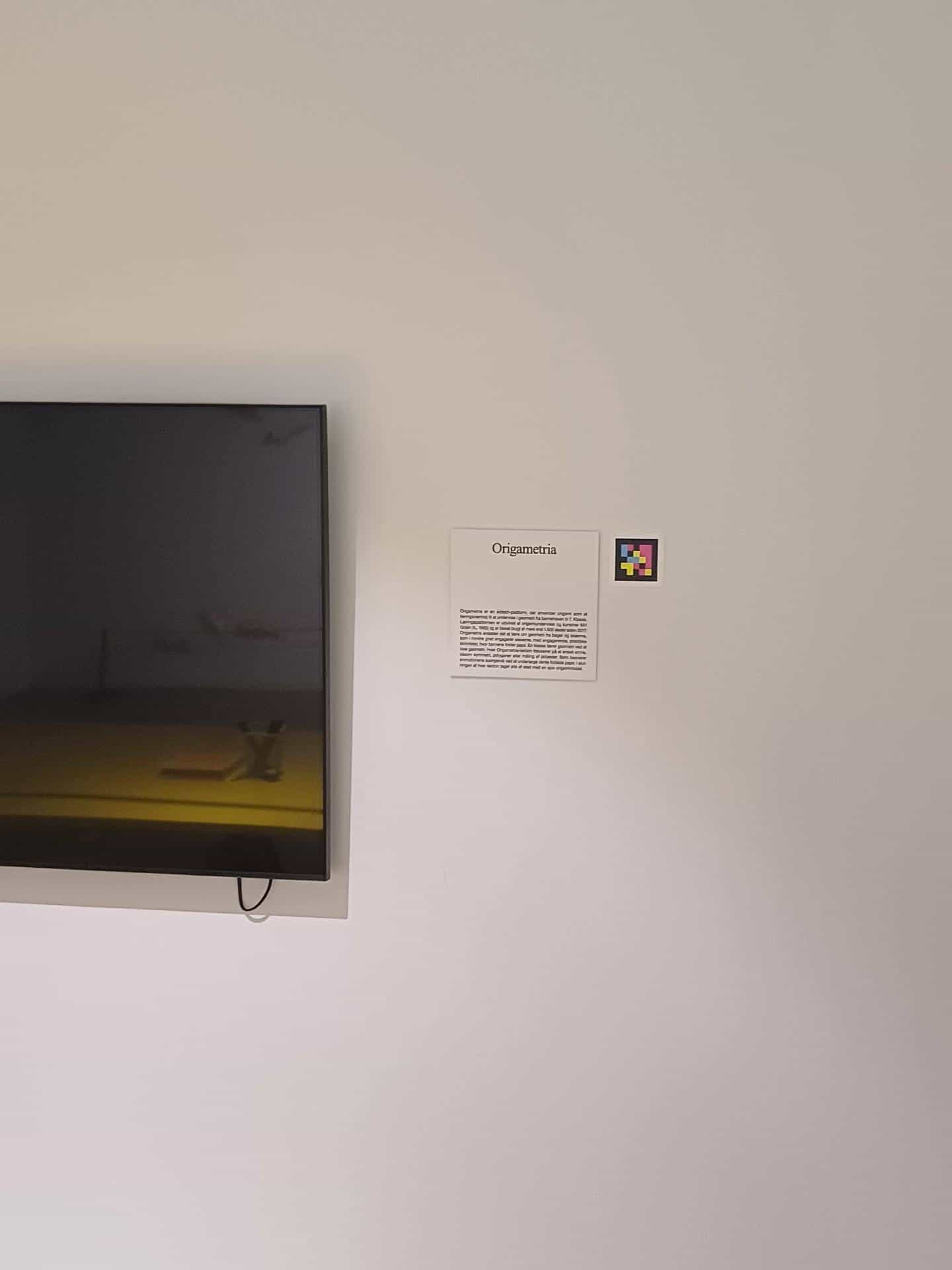
Education room
Origametria — teaching method
The Origametria area—Miri Golan's method for teaching geometry through origami—comes with a NaviLens code beside the text panel and the video monitor. The methodology is heard by voice, complementing the visual content.
§ What they said
“Hemos comprobado que las personas ciegas y con baja visión rara vez usan braille; lo que sí utilizan son sistemas de navegación como NaviLens. Una app así debe pensarse desde el inicio del diseño expositivo si se quiere incluir de verdad a personas con discapacidad visual.”
“Resulta muy interesante ver cómo una obra que para mí es puramente visual, para una persona con discapacidad visual se convierte en una narración cuando palpa el papel y descubre que está hecho con tiras de braille.”
§ Results
A museum for everyone.
Accessible label
Author, work, year and technique read aloud in 42 languages
Independent visit
Blind or low-vision people walk the room without a guide
International tourism
Visitors from any country hear the labels in their language
§ And your destination?
Your destination can also guide in 42 languages.
Tell us about your trails, visitor centers, landmarks or galleries. We’ll show you how NaviLens would make your offering accessible—with comparable cases.