GS1 Sunrise 2027 and accessible connected packaging: insights from Esko World 2026
As retail shifts to 2D barcodes, GS1 Sunrise 2027 reopens the question of what a pack can connect. Key takeaways from Esko World 2026 on why accessibility must be designed into the touchpoint from the start, not bolted on at the end.

Connected packaging can serve brands, retailers, supply chains and consumers—but only when every person can independently find and use its digital touchpoint.
At Esko World 2026 in New Orleans, NaviLens joined experts from across the packaging ecosystem to discuss how the transition to 2D barcodes is changing the relationship between physical products, data and consumers.
Lorenzo Campos, CEO of NaviLens, took part on 4 June in the Executive Track panel “The Pack as a Platform: Unlocking Sales Uplift Through Connected Packaging”, alongside representatives from Esko, GS1 US, io.tt, Scantrust, Zappar and Amazon Transparency.
The discussion covered GS1 Sunrise 2027, serialisation, dynamic code management and the use of one on-pack code for consumers, retailers, brands, auditors and supply-chain partners. As packaging becomes a digital platform, however, the industry must also ask whether every consumer can independently find and use that code.
What GS1 Sunrise 2027 changes
GS1 Sunrise 2027 is an important milestone in retail’s transition towards two-dimensional barcodes. The objective is for point-of-sale systems to process defined 2D barcodes using GS1 standards by the end of 2027. It does not mean that every linear barcode will disappear immediately: different data carriers may coexist while systems and processes are updated.
GS1 2D barcodes can carry identifiers and connect to batch, serial or expiry data, traceability, authentication, instructions, ingredients, allergens, recycling guidance and digital experiences. A QR Code carrying a GS1 Digital Link URI can also connect a physical product to online resources maintained by the brand. More information behind a code does not automatically make that information accessible.
One code, multiple business outcomes
A retailer may need an identifier at checkout; a supply-chain partner may need traceability; a brand may offer support or authentication; and a consumer may want ingredients, instructions or recycling guidance. Packaging is therefore increasingly treated as a data platform rather than a static container.
One code does not mean one identical experience for everyone. People may need different interfaces, formats and interaction methods. For blind and low-vision consumers, the main barrier can occur before any digital content opens.
Making connected packaging accessible by design
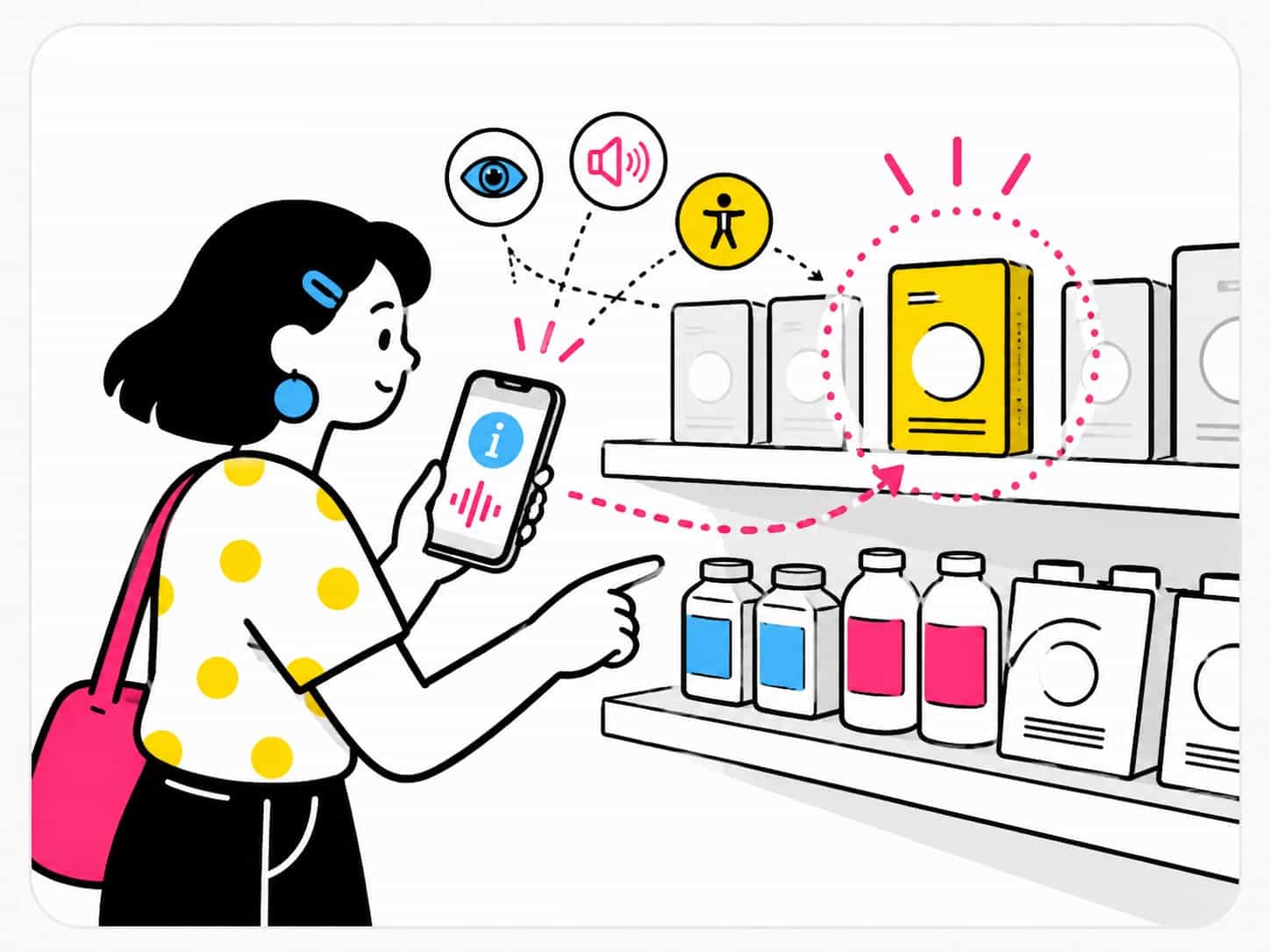
Connected packaging delivers its full value only when every consumer can independently access its digital touchpoint. For blind and low-vision people, accessibility begins before the scan: they must first discover the product and locate its access point.
NaviLens Accessible QR brings NaviLens long-distance detection technology to standard QR and GS1 Digital Link codes. It helps consumers locate and access content without precise aiming, framing or focusing, while preserving the original QR and its retail, traceability and consumer-engagement functions.
Building accessibility into the same touchpoint can support inclusive experiences alongside compliance, traceability and engagement objectives. Accessibility can become part of a Sunrise 2027 strategy from the outset rather than a separate project added at the end.
“Accessible by design” also has a very practical implication: NaviLens codes should be embedded directly in the packaging design phase, as one more element of the artwork, rather than added once the design is finalised. In that direction, NaviLens and Esko are working on a solution for seamlessly integrated artwork management for connected packaging, allowing brands to approve both the visible on-pack elements and the accessible off-pack data in a single workflow, directly within the Esko software.
"Sunrise 2027 is a unique opportunity to ensure that connected packaging works for everyone from day one. True accessibility is not only about providing information—it is about enabling every consumer to independently discover, identify and access products. By embedding accessibility into the same digital infrastructure that supports GS1 Digital Link, brands can make inclusion a standard feature of connected packaging rather than an afterthought."
Accessibility begins before the scan
A conventional QR code assumes that a user can see it, point a camera towards it, frame it and wait for focus. For a person who is blind or has low vision, these actions can be the main barrier.
The journey has two distinct stages. First, discovery and identification: knowing the access point exists, locating it and understanding which product it belongs to. Second, access to information: opening, navigating and understanding the content through an accessible digital interface.
A website can meet accessibility requirements and remain practically unreachable when a consumer cannot independently find the code that leads to it. The complete journey, from physical product to digital destination, must be considered.
How NaviLens Accessible QR fits into a connected packaging strategy
NaviLens Accessible QR preserves the conventional QR and adds a high-contrast visual layer designed to make it easier to detect with the NaviLens applications. This retains the existing QR journey while improving the ability of blind and low-vision people to locate it.
For QR Codes using GS1 Digital Link, accessibility can be considered within the same strategy for identification, traceability, information and engagement. This does not mean that GS1 officially recommends NaviLens, nor that any technology by itself guarantees regulatory compliance.
The code is only one part of the implementation
Brands must also review several aspects of the pack and its digital destination:
- Code placement, size and contrast on the pack
- Print quality
- Accessible digital content, compatible with screen readers
- Text enlargement and sufficient contrast
- Data ownership and maintenance
- Testing with blind and low-vision users
NaviLens Accessible QR is particularly relevant when a QR-based journey exists or is planned; it is not a universal replacement for every accessibility solution. The original NaviLens technology supports broader long-distance detection, contextual identification, directional information and wayfinding in transport, buildings, public spaces and tourism. The appropriate technology depends on context and task.
For more context, read our guide to accessible QR codes and explore accessible packaging.
Five accessibility questions for a Sunrise 2027 roadmap
These five questions help check whether connected packaging truly works for everyone, beyond the design file:
1. Can the code work throughout the ecosystem?
It must work on the final printed product, at point of sale and in relevant supply-chain processes. Testing only a digital artwork file is not enough.
2. Is the information structured and maintained?
Brands must define where information lives, who owns and approves it, and how it is updated. An outdated or unavailable destination limits the code’s value.
3. Can consumers discover the access point?
The presence of a QR code does not guarantee that everyone can find it. Placement, size, contrast and detection method are part of the experience.
4. Is the digital destination accessible?
The website or service should support screen readers, text enlargement, sufficient contrast, logical headings, keyboard interaction and clear language.
5. Has the complete journey been tested?
Testing with real users must include the physical pack: discovering the product, locating the access point, identifying the item, opening information, navigating and completing the task independently.
Lessons from Esko World 2026
Esko World showed that packaging’s future depends on connected ecosystems rather than isolated technologies. Design, artwork, product data, printing, traceability, retail and consumer experience increasingly need to work together.
Accessibility belongs in that same process. Considered during the brief, data architecture and design, it can be validated alongside print quality, brand, traceability and point-of-sale performance. Left until the end, it risks becoming an accessible webpage that some consumers still cannot find.
Making inclusion part of the infrastructure
GS1 Sunrise 2027 is not, by itself, an accessibility standard. It is, however, a moment when brands, retailers and providers are reconsidering codes, data, artwork and digital experiences—an opportunity to ask not only what information packaging can connect, but who can find and use it.
Success should be measured not only by connected data, systems or interactions, but by the independence provided. Including accessibility in the infrastructure used for GS1 Digital Link, traceability and engagement can help make the next generation of packaging smarter, more connected and usable by more people.
Frequently asked questions
- What is GS1 Sunrise 2027?
- It is an industry milestone intended to prepare retail point-of-sale systems to process defined 2D barcodes using GS1 standards by the end of 2027, supporting richer product data, traceability and connected experiences.
- Does GS1 Sunrise 2027 automatically make packaging accessible?
- No. Accessibility also depends on whether consumers can independently find and scan the code and use an accessible digital destination.
- Can NaviLens Accessible QR be used with GS1 Digital Link?
- It can add a location-oriented accessibility layer to a new or existing QR Code carrying a GS1 Digital Link URI while preserving the original QR journey. Implementation should be assessed for the pack, print process, data and user needs.
- Is NaviLens Accessible QR the same as the original NaviLens technology?
- No. NaviLens Accessible QR improves discovery of a QR-based information point. The original NaviLens technology provides broader contextual identification, directional information and wayfinding capabilities.
- Why does accessibility need to begin before the scan?
- Because digital content cannot provide an independent experience if a person cannot find the physical access point that leads to it.