Case study · Torrent (Valencia)
A falla you can listen to: Inclusivament.
The children's falla by the Cronista Vicent Beguer i Esteve commission in Torrent embeds NaviLens codes with audio description in Valencian and Spanish from the TRAMA group at UJI: blind and low-vision visitors listen to every scene of the monument from the free app.
Mar 2025
Falles, 16–19 March in Torrent
Special Sec.
Children's falla Cronista Vicent Beguer i Esteve
5 senses
Sounds, scents, textures and edible ninots
VAL · ES · EN
Multilingual audio description via NaviLens
The project
Inclusivament
Falla Cronista Vicent Beguer i Esteve
The A.C. Falla Cronista Vicent Beguer i Esteve in Torrent (l'Horta Sud) raised at Falles 2025, in the children's Special Section, the monument “Inclusivament”, designed by artist Grego Acebedo: five scenes exploring forms of communication—wallet, referee, police, social media, telephone game—designed to be enjoyed with the five senses.
The professional audio description, in Valencian and Spanish, was authored by researcher Vanessa Gumier from the TRAMA group (Translation for Audiovisual Media and Accessibility) at Universitat Jaume I in Castelló. NaviLens was chosen as the carrier: it can be scanned from several yards away, without focusing and with the white cane still in the other hand.
Partners on the project included social organizations such as Adisto, Plena Inclusión Comunitat Valenciana, Aldaia Inclusió and ONCE, alongside the commission's own Casal, already signposted with pictograms and braille.
§ The challenge
Make the falla something you can touch, smell and hear.
- 01
A falla you can't touch: how do you experience it without seeing it?
Fallas are deeply visual—volumes, color, scenes—and they are fenced off. For a blind or low-vision person the monument stays out of reach. Cronista wanted to break that barrier without giving up the character of the cadafal.
- 02
Audio-describing five scenes in Valencian and Spanish
Grego Acebedo's Inclusivament project frames communication through the five senses: wallet, referee, police, social media and telephone game. Each scene needed a short, faithful voice-over in two languages, produced with professional accessibility criteria.
- 03
Activating the content out on the street, in March
The carrier had to work outdoors, with no power supply, withstand Falles rain and sun and let the visitor pick language and video from their phone. Classic QR codes require close focus; a white cane does not focus.
§ The solution
Five codes, one lectern, the whole falla in your ear.
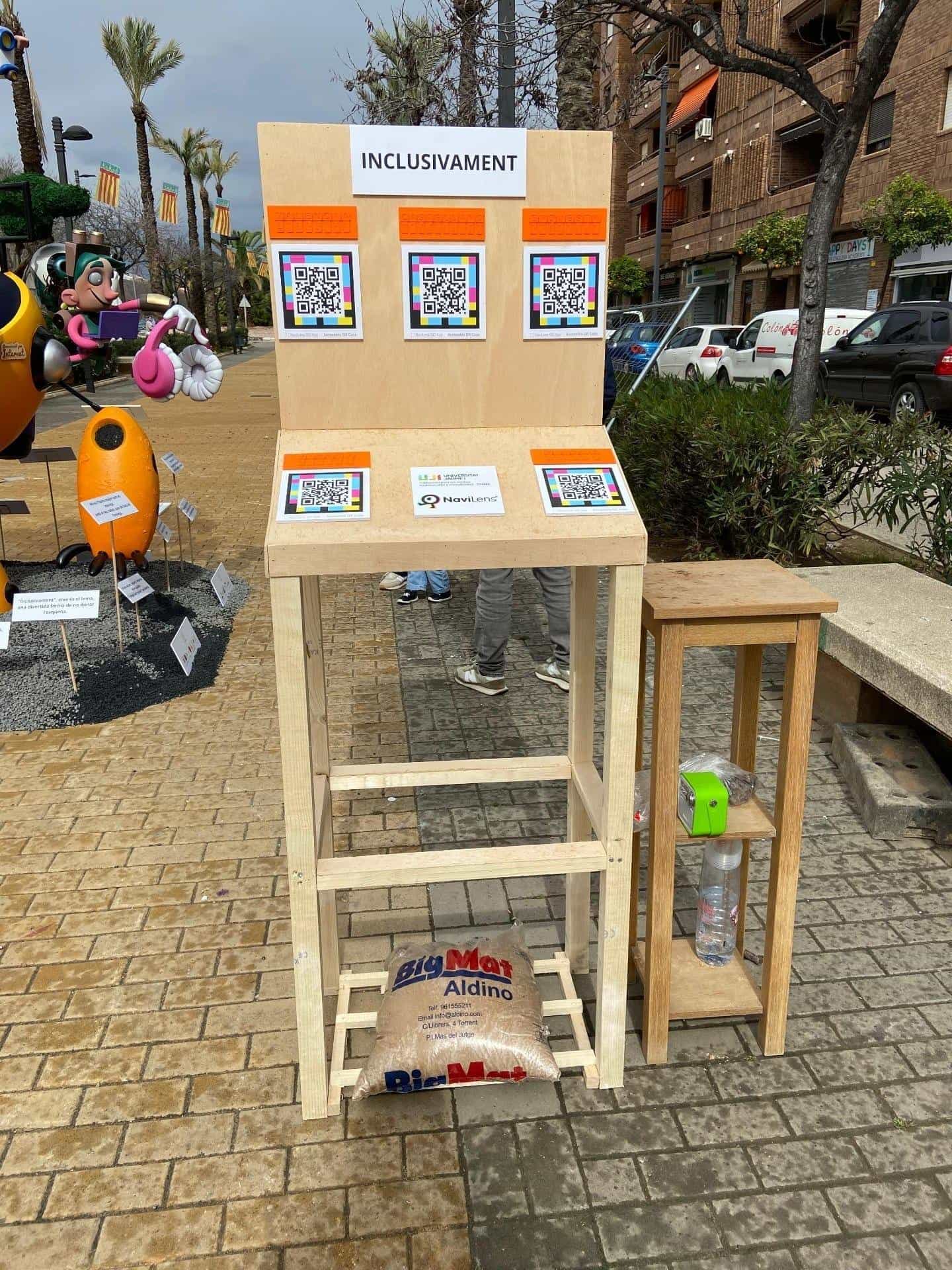
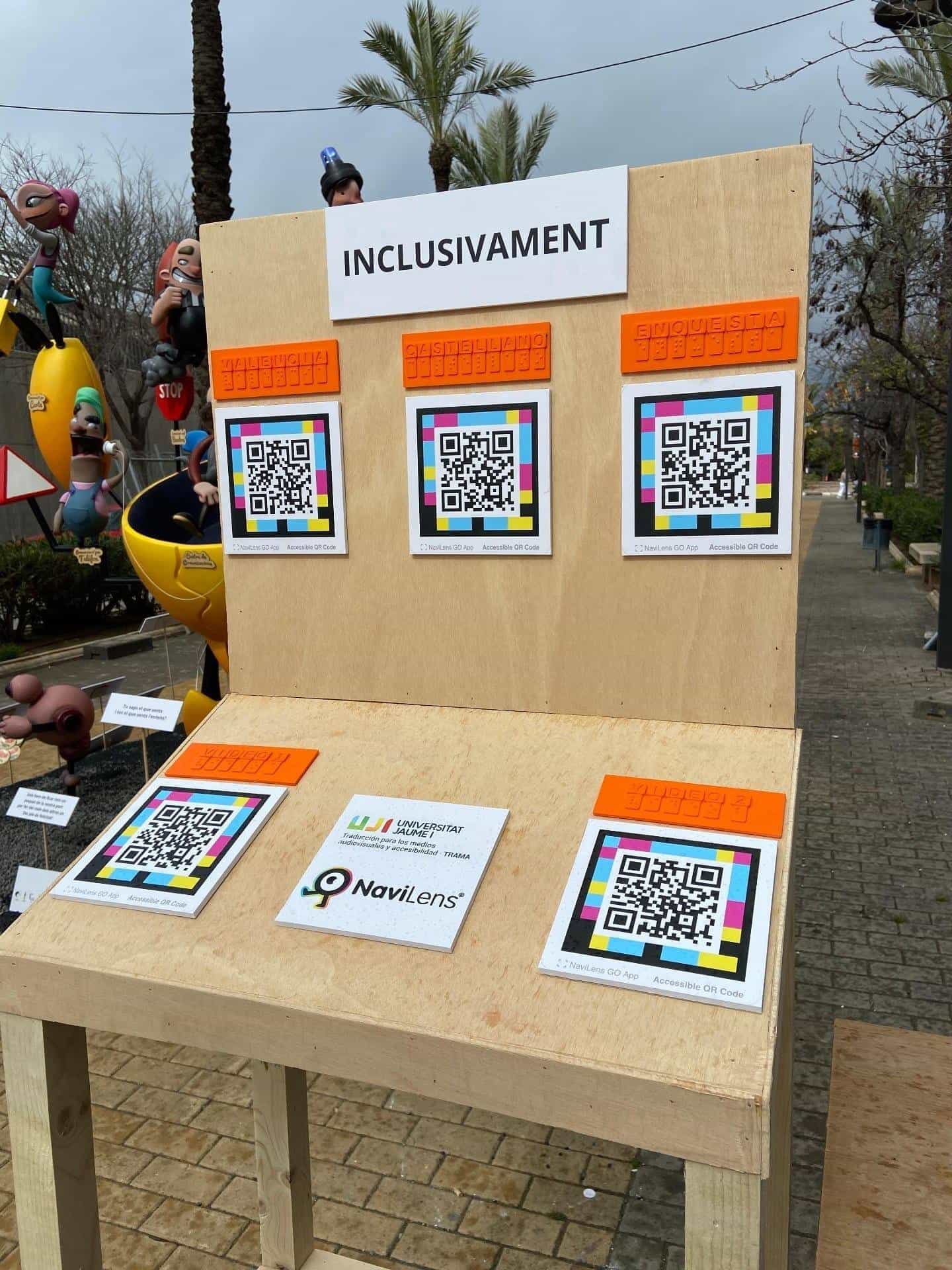
Next to the cadafal fence the team installed a wooden cadireta with five large NaviLens codes, labeled in braille and print: Valencià, Castellano, Vídeo 1, Vídeo 2 and an evaluation Enquesta.
With the free NaviLens GO app the user scans the code they prefer from 1–6 feet away and listens to the professional audio description produced by TRAMA at UJI, complemented by sounds, textures, scents and edible ninots placed on the monument itself.
The survey—also accessible via NaviLens—allowed the research team to measure the experience of users, turning the falla into an academic case study of outdoor cultural accessibility.
§ At the cadafal
Inclusivament, scene by scene.
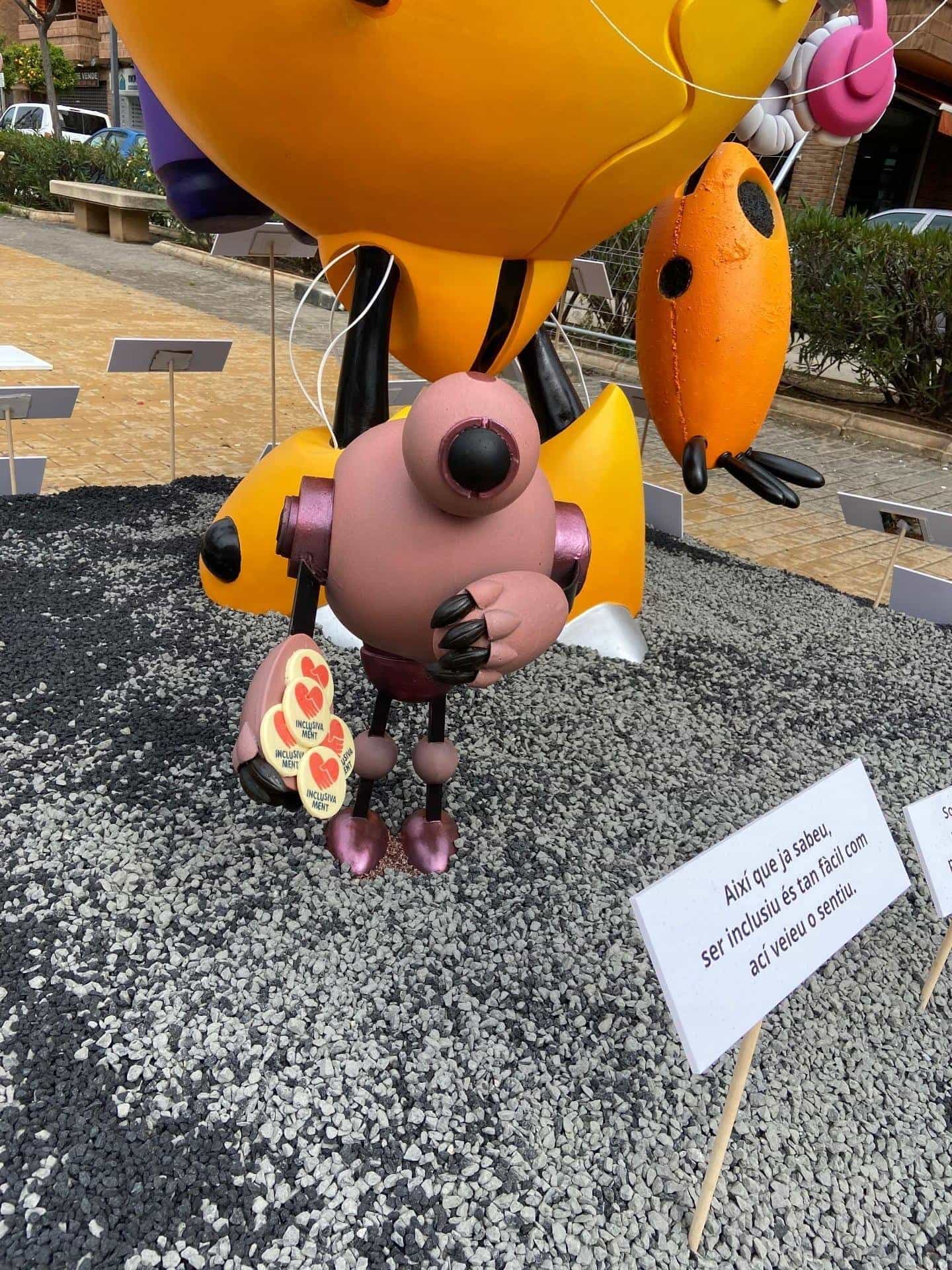
The children's ninot selected for the Exposició del Ninot, held at the Sala Cívica del Antic Mercat in Torrent (25 Feb – 14 Mar 2025), was already designed for sensory accessibility from the previous exhibition itself.
§ Why it matters
The first falla designed for blind people.
5 senses
sounds, textures, scents, edible ninots and NaviLens audio description live on the same monument, without replacing the visual experience for other visitors.
UJI
audio description produced with academic criteria by the TRAMA group at Universitat Jaume I, in Valencian and Spanish, within a project evaluated through a survey.
International
‘Inclusivament’ has become an academic and festive reference and traveled beyond the Comunitat Valenciana as a replicable model of an accessible falla.
§ Sources
- Universitat Jaume I — “Researcher Vanessa Gumier (TRAMA) writes the audio description integrated into the children's falla Cronista Vicent Beguer i Esteve in Torrent” (14 Mar 2025).
- TRAMA · UJI — “A sensory falla in Torrent” (21 Feb 2025).
- Ruvid — “Vanessa Gumier writes the audio description integrated into the children's falla Cronista Vicent Beguer i Esteve in Torrent”.
- Levante-EMV — “A falla for the five senses: Cronista of Torrent unveils an inclusive children's project for 2025” (17 Jun 2024).
- elperiodic.com — “Sounds, scents and edible ninots: Torrent will host the first falla for blind people”.
- A.C. Falla Cronista Vicent Beguer i Esteve — “Inclusivament is now international”.
§ And your destination?
Your destination can also guide in 42 languages.
Tell us about your trails, visitor centers, landmarks or galleries. We’ll show you how NaviLens would make your offering accessible—with comparable cases.