Case study · Ise, Mie (Japan)
A city hall that walks you to the desk.
Ise (Mie) and the Ise Blind Welfare Association trial NaviLens at city hall: around 50 tags between the main door and the Welfare desk, walked by blind and low-vision users and covered by Chunichi Shimbun.
30 Jan 2022
Pilot at Ise City Hall (伊勢市役所)
~50 tags
NaviLens codes on floors and walls
~50 m
From the main entrance to the Welfare desk
10+ people
Association + volunteers + city hall staff
The client
Ayuntamiento de Ise
& 伊勢市視覚障害者福祉会
Ise (伊勢市), in Mie Prefecture, is home to the Ise Grand Shrine (Ise Jingū) and a major destination for domestic and international tourism. Its City Hall runs dedicated support programs for blind and low-vision residents (home training, deaf-blind interpreters, etc.).
The 伊勢市視覚障害者福祉会 — Ise Blind Welfare Association (isebl.com) is the local association of blind and low-vision people, with over a century of history. Together with the city hall it organized the NaviLens trial on 30 January 2022 with support from the Mie Barrier-Free Tour Center (Toba).
§ The challenge
Letting public services explain themselves without reading.
- 01
Reaching the right desk without seeing the signs
The test route linked the main entrance with the Welfare Desk for Elderly and Disabled People (高齢・障がい福祉課) on the ground floor of the East Building (東館). A short distance on the map, but full of glass walls, numbered counters and signs in Japanese only.
- 02
Co-designed with blind people, not “for” them
The trial was driven by Ise City Hall itself and the 伊勢市視覚障害者福祉会 (Ise Blind Welfare Association). Three blind and low-vision users walked the building with cane and phone and afterwards discussed what worked and what should improve.
- 03
A layer that also serves international tourism
Ise, home to the Jingū, receives huge numbers of tourists. The closing discussion pointed to extending codes to vending machines, cafeteria menus and tourist routes — leveraging NaviLens' support for dozens of languages beyond Japanese.
§ The solution
An accessible route from the door to the desk.
~50 paper-printed NaviLens tags are placed a few yards apart on floors and walls, covering the ~50 m between the main entrance and the Welfare Desk for Elderly and Disabled People. The app announces by voice the next reference and the distance to the destination.
Nothing installed in the building: just printed signs + the visitor's smartphone. The same app that already guides at MTA New York, EUIPO Alicante and Kobe City Hall.
§ Timeline
A pilot opened to public debate.
- 30 Jan 2022
Trial at Ise City Hall
Ise City Hall (伊勢市) and the Ise Blind Welfare Association (伊勢市視覚障害者福祉会) run a public NaviLens trial. Three blind and low-vision users walk the route from the main entrance to the 1st-floor Welfare desk in the East Building with their smartphone — about 165 feet signposted with around 50 tags printed on floor and walls.
- 31 Jan 2022
Coverage in Chunichi Shimbun (中日新聞)
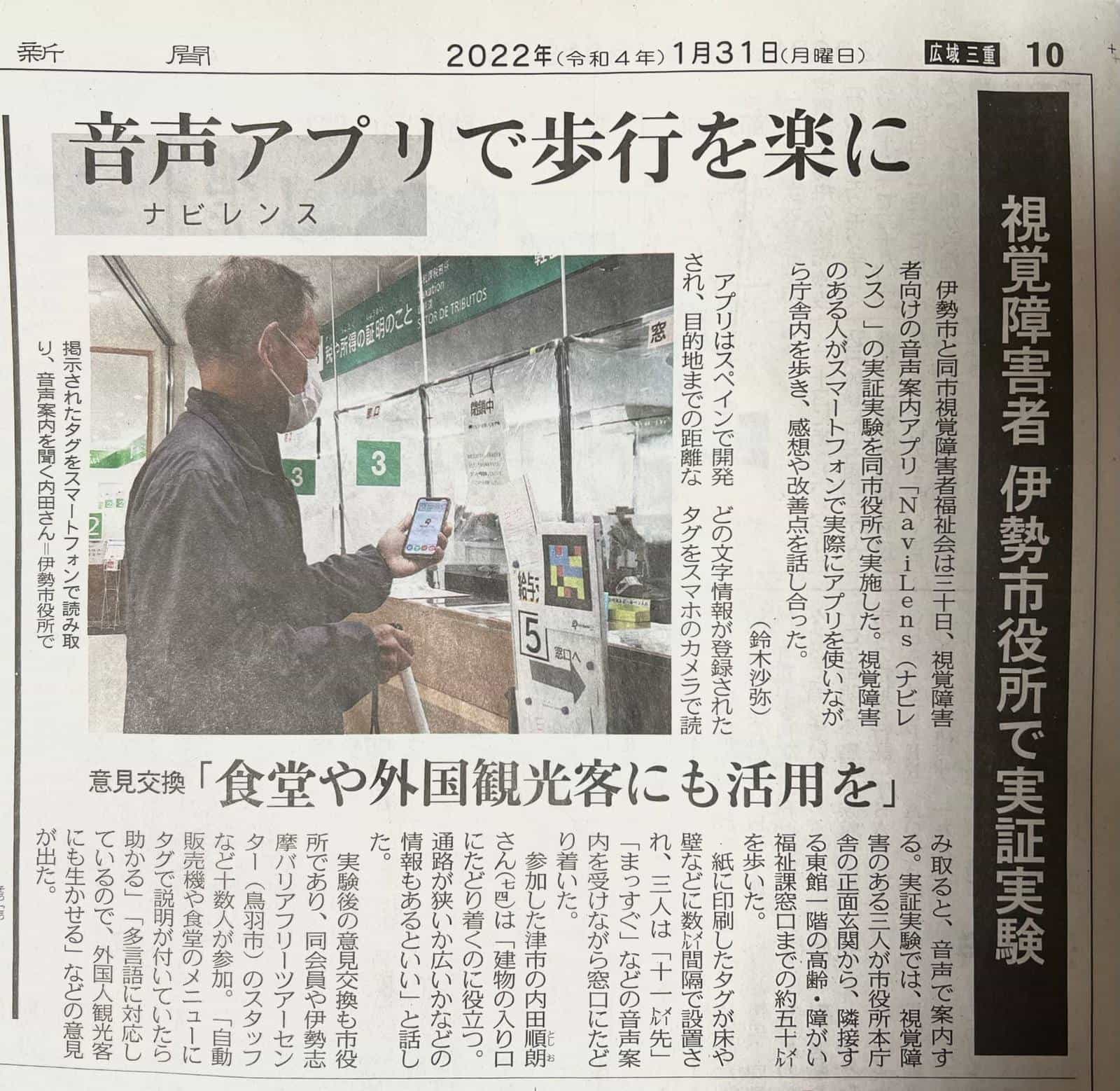
Regional daily Chunichi Shimbun publishes the report “Voice app makes walking easier” in its Kōiki Mie edition (広域三重, p.10), signed by reporter Saya Suzuki, with a photo of Toshio Uchida (Tsu, 71) using the app in front of counter no. 5.
- After the trial
Improvements meeting: vending, menus and tourism
Members of the Mie Barrier-Free Tour Center (Toba) and Ise-Shima municipal staff also take part. Proposals include extending the tags to vending machines, cafeteria menus and, given the app's multilingual support, to assistance for foreign tourists.
§ What they said
What Chunichi Shimbun and the Ise Blind Welfare Association said.
“Voice app makes walking easier — On the 30th, the city of Ise and its local Blind Welfare Association ran a trial of the voice guidance app “NaviLens” at city hall. Three blind and low-vision people walked through the building using the app on their smartphones and discussed feedback and improvements afterwards.”
“They walked about 165 feet from the main entrance of city hall to the Elderly and Disabled Welfare counter on the first floor of the adjacent East Building. Paper-printed tags were placed every few yards on floor and walls and also showed the distance to the destination.”
““Also useful for cafeterias and foreign tourists” — Mr Junro Uchida (71, from Tsu) said: “It helps me reach the entrance of the building. Information like whether the corridor is narrow or wide would be useful too”.”
§ Results
An accessible administration with nothing installed in the building.
1 app
NaviLens free — no proprietary city hall app
0 hardware
Just printed signs on floors and walls
Multi-language
Voice in dozens of languages — useful for international tourism
§ And your headquarters?
Your office can also welcome in 42 languages.
Tell us about your building, your services and your visitors. We’ll show you how NaviLens would make your office truly accessible.