Case study · Miami · Florida · USA
Government Center speaks: Miami-Dade DTPW pilots NaviLens at its multimodal hub.
The Miami-Dade Department of Transportation and Public Works (DTPW) launches the first accessible navigation tool at a county transit station: a proof of concept with NaviLens at Government Center Station, the multimodal hub where Metrorail, Metromover, Metrobus, Broward County Transit buses and the pedestrian bridge to MiamiCentral all converge. High-contrast codes on top of existing signage, voice readout at 100 ft, without focusing, in 42 languages.
1st in the county
First Miami-Dade station with voice-driven accessible navigation
Metrorail · Metromover · Metrobus
Multimodal hub connecting MiamiCentral (Brightline · Tri-Rail)
42 languages
Voice readout from over 100 ft, no focusing
No construction
Stuck onto existing signage with no architectural changes
The operator
Miami-Dade DTPW · Department of Transportation and Public Works
The Department of Transportation and Public Works (DTPW) runs the Miami-Dade County transit system — Metrorail (25 miles of elevated heavy rail, 23 stations), the free downtown Metromover, Metrobus and STS paratransit — serving a county of more than 2.7 million residents and millions of visitors a year.
Government Center Station is the intermodal heart of downtown Miami: a transfer node between Metrorail and Metromover, a terminal for Metrobus and Broward County Transit, and connected via a pedestrian bridge over NW 3rd Street to MiamiCentral — the Brightline and Tri-Rail station. Every day, government-district workers, tourists and residents combine two or three modes here in a single trip.
In 2025, DTPW —led from Jarice Rodriguez's office— picked Government Center to launch a proof of concept with NaviLens: the first accessible navigation tool deployed at a county transit station. The goal is to understand how blind, low-vision, cognitively impaired or non-English-speaking riders find their way between Metrorail, Metromover and the Omni and Brickell loops — and to validate the model before scaling it across the network.
§ How it was deployed
Voice wayfinding in a multimodal hub.
- 01
Codes on top of existing signage
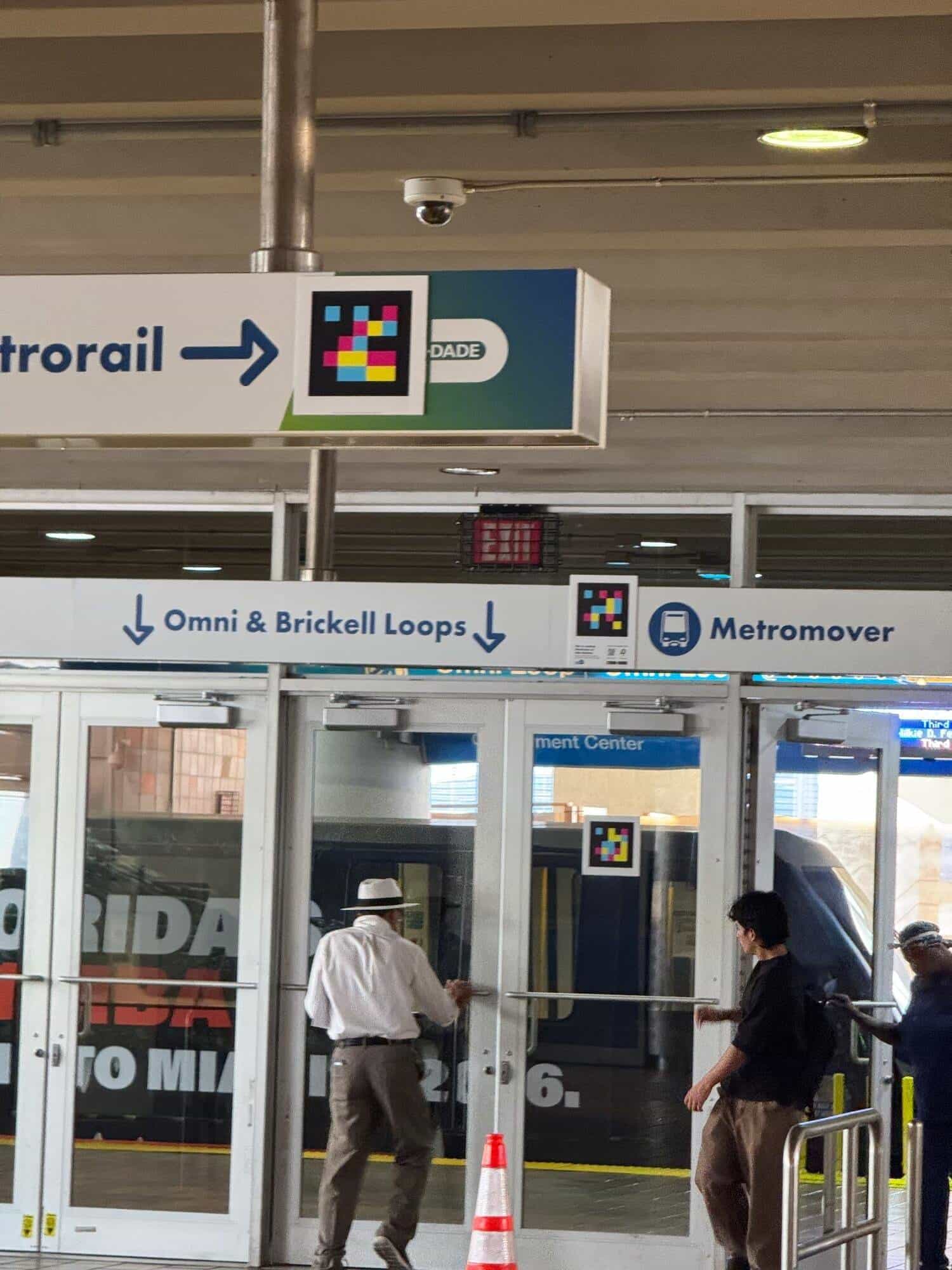
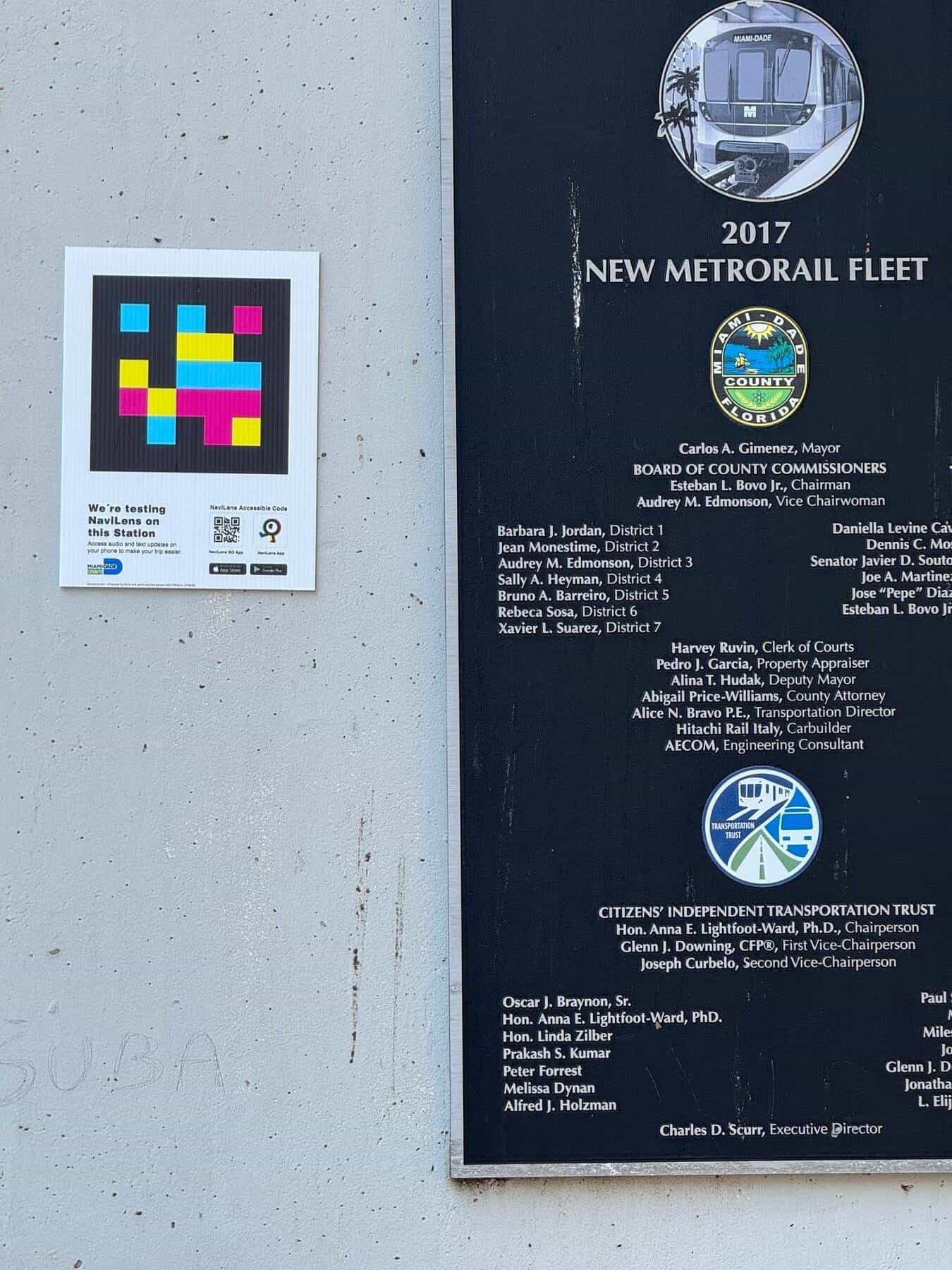
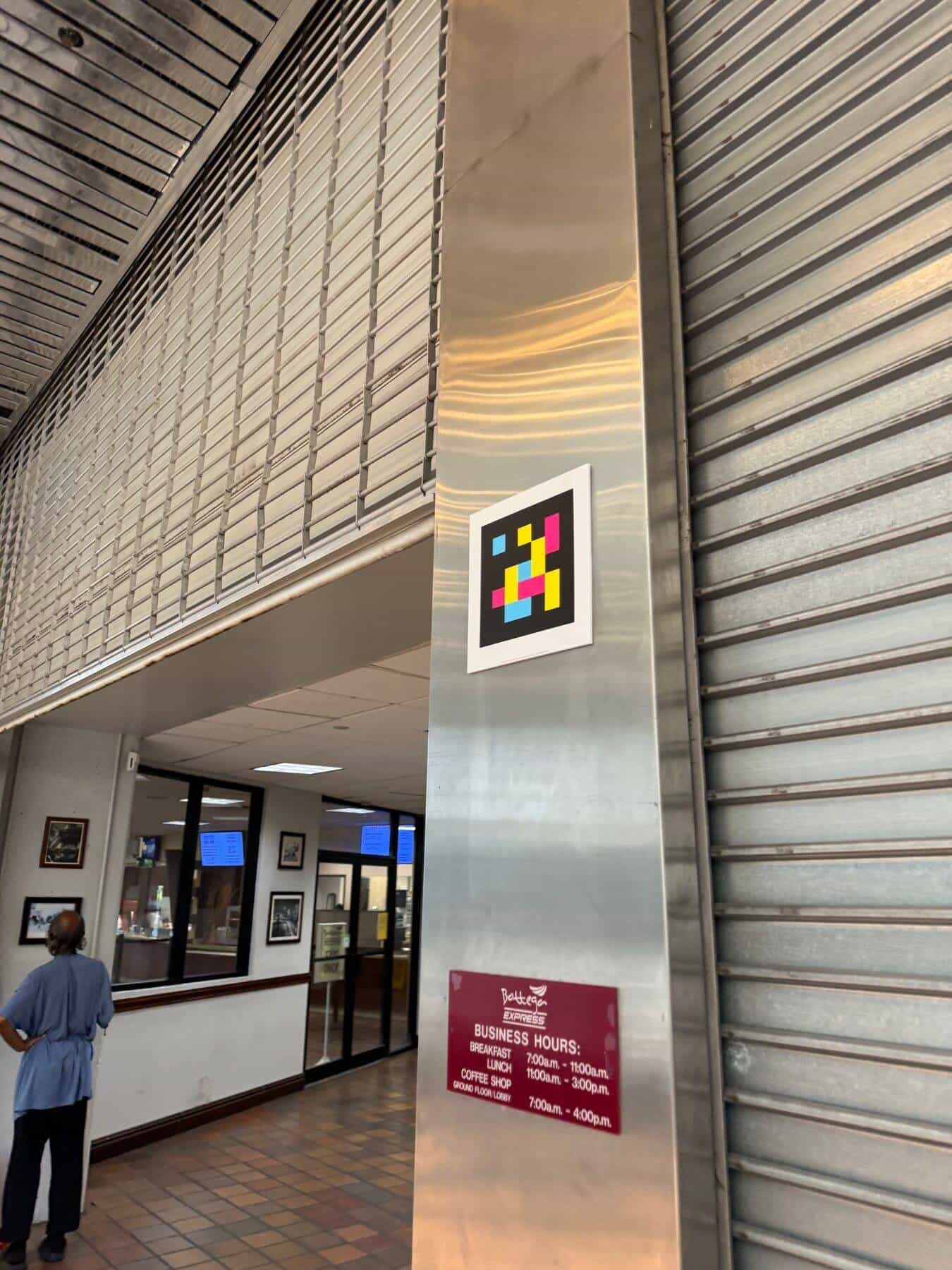
NaviLens codes are embedded in the hanging “Metrorail →” wayfinding signs, on the doors leading to the Metromover's Omni & Brickell Loops and next to the train pictogram — without replacing any of Miami-Dade Transit's visual signage and without structural changes to the station.
- 02
Critical points identified
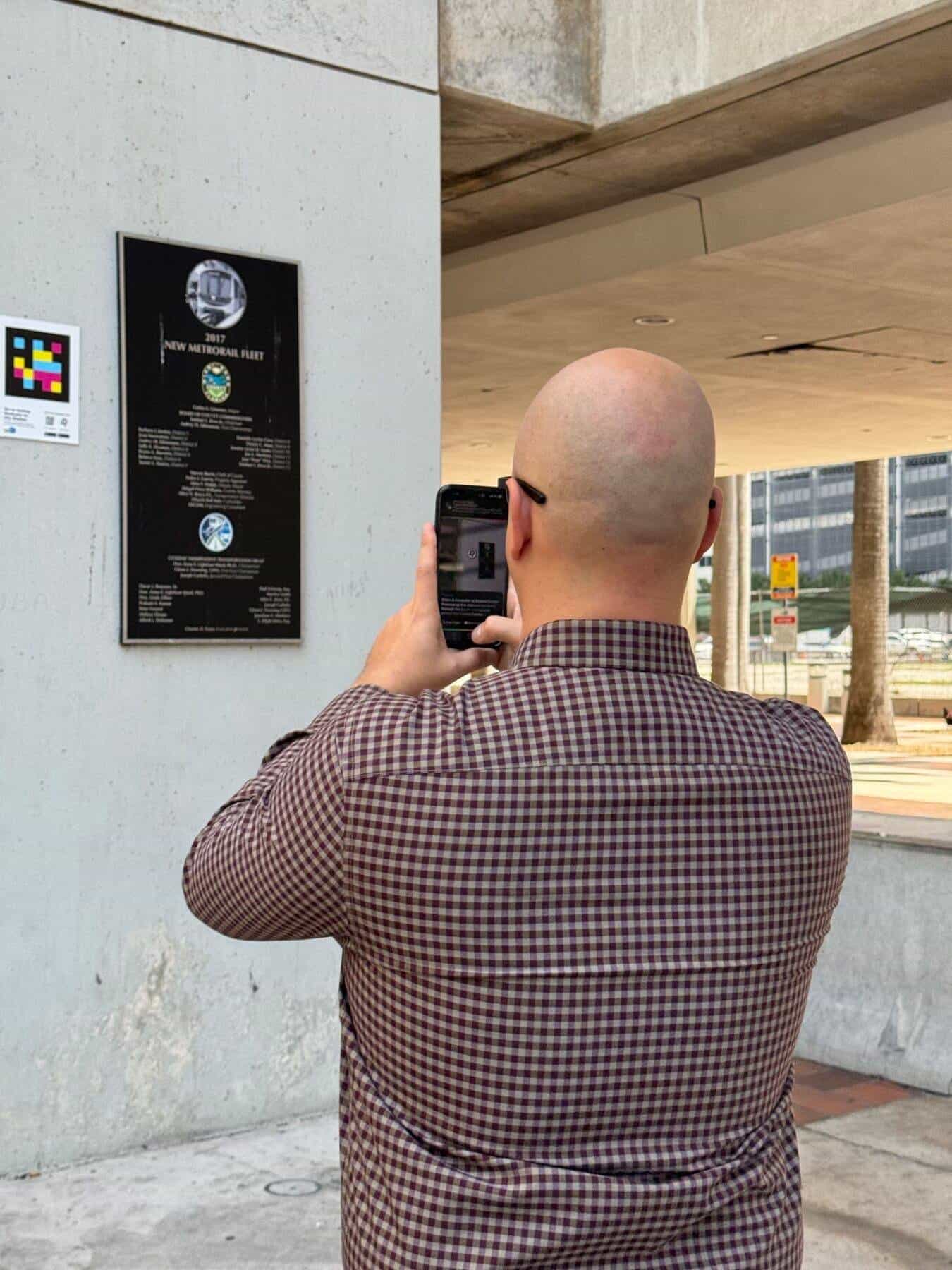
Beyond modal wayfinding, each code is programmed with point-of-interest data: Metrorail platforms, Metromover access and its loops, Metrobus connections and the MiamiCentral bridge, plus customer services and commemorative plaques such as the “2017 New Metrorail Fleet” one.
- 03
A measurable proof of concept
The pilot is designed as a proof of concept: “We're testing NaviLens on this Station” signage with QR codes to download the NaviLens and NaviLens GO apps, feedback gathering from blind and low-vision riders, and an international benchmark with LA Metro Union Station, MTA New York and TfL London ahead of a system-wide rollout.
§ Government Center gallery
The downtown hub, now audible.
§ § NaviLens at Miami · video
Government Center, in motion.
Real-world walkthrough at the multimodal hub showing how NaviLens codes — at the Metrorail entrance, on columns and on commemorative plaques — are read from a distance and without aiming. The same code network serves phones and smart glasses, supporting blind and low-vision riders, international travelers and anyone who needs instant orientation.
Government Center Station · Miami-Dade DTPW
§ Why it matters
Multimodal accessibility for downtown Miami.
First deployment
It is the first accessible navigation tool DTPW has deployed at a Miami-Dade transit station. It sets a replicable precedent for all 23 Metrorail stations and Metromover stops.
Truly multimodal
Government Center concentrates Metrorail, Metromover (Omni and Brickell loops), Metrobus, Broward Transit and the bridge to MiamiCentral. NaviLens stitches those modes together by voice, in real time, without forcing riders to decode two parallel signage systems.
42 languages for Miami
In a bilingual English / Spanish city with a constant flow of Latin American, Brazilian, European and Caribbean visitors, reading each sign in the rider's phone language is not a bonus — it is what separates an accessible system from one that merely complies.
“Multiple Lenses” · phone + Meta
The pilot is framed around multiple “lenses” of access: the NaviLens and NaviLens GO apps on the rider's smartphone plus integration with Meta smart glasses for hands-free scanning. The same network of codes serves blind, low-vision and cognitively impaired riders, as well as visitors — without locking them into a single device.
§ And your network?
Your next station can also speak.
Tell us about your network, your pain points and the KPIs you want to move. We’ll show you how NaviLens would fit—with comparable cases.