Case study · Metro Vancouver
The first time a Canadian public-transport network speaks out loud.
In January 2023, TransLink launched the Accessible Navigation Project: 16 NaviLens codes across 3 sites in Metro Vancouver, guiding blind and low-vision riders by voice from the curb to the exact bus-boarding point. Canada's first NaviLens deployment.
Vancouver · BC
Canada's first NaviLens deployment (TransLink, 2023)
16 NaviLens codes
3 sites: New Westminster SkyTrain, CNIB and VCC
14 m detection range
No aiming, on the move and in any lighting
6-month pilot
“Accessible Navigation Project”, with evaluation to scale
The client
TransLink Metro Vancouver
TransLink (South Coast British Columbia Transportation Authority) is Metro Vancouver's regional transport authority: it operates and plans bus, SkyTrain, SeaBus and West Coast Express, plus the regional road network.
In January 2023 it announced the Accessible Navigation Project, a Canada-first pilot bringing NaviLens technology into the network, in partnership with organizations such as CNIB (Canadian National Institute for the Blind) and ASIC (Access for Sight-Impaired Consumers).
The project joined a broader accessibility roadmap: TransLink was already adding braille across its ~8,400 stops and tactile paving across its own properties.
§ The challenge
Letting anyone find their bay, not just “the stop”.
- 01
A very dense regional network
TransLink runs ~8,400 bus stops across Metro Vancouver, plus SkyTrain, SeaBus and West Coast Express. For a blind or low-vision rider, finding the right pole, bay and exact boarding spot in the dark or in heavy traffic was not trivial.
- 02
Braille and tactile paving solved “right next to”, not “33 feet away”
Since 2021 TransLink has been adding braille to every stop and tactile paving on its own property. An essential layer — but it only helps once you're already touching the pole. Something audible that could be “seen” from a distance was still missing.
- 03
Testing new tech safely
It was the first NaviLens deployment in Canada. The pilot had to be validated with real users (CNIB, ASIC) across contrasting settings—open street, covered interchange and community spaces—before considering a region-wide expansion.
§ The solution
NaviLens decals on every pole, audio that arrives before the bus does.
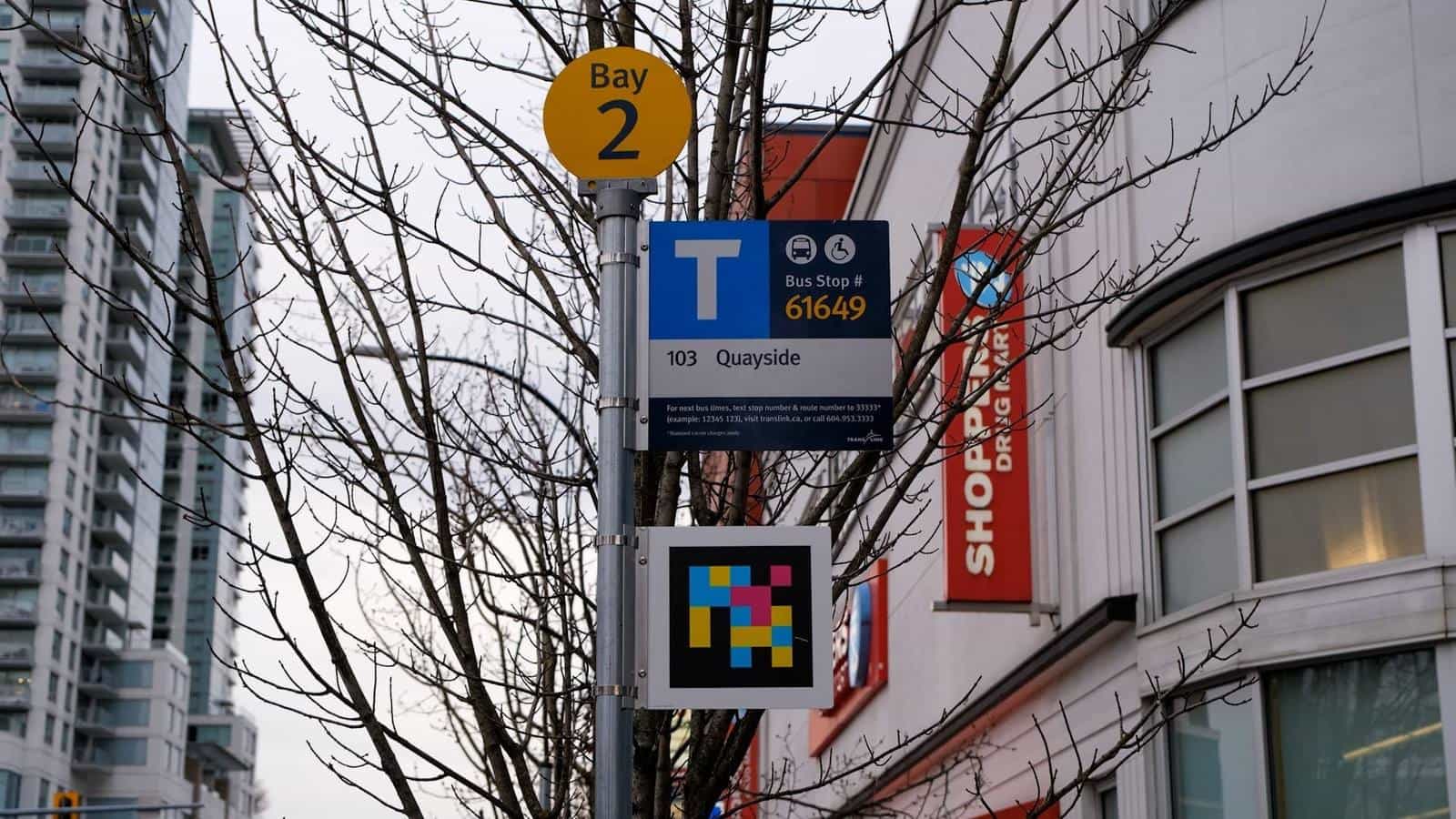
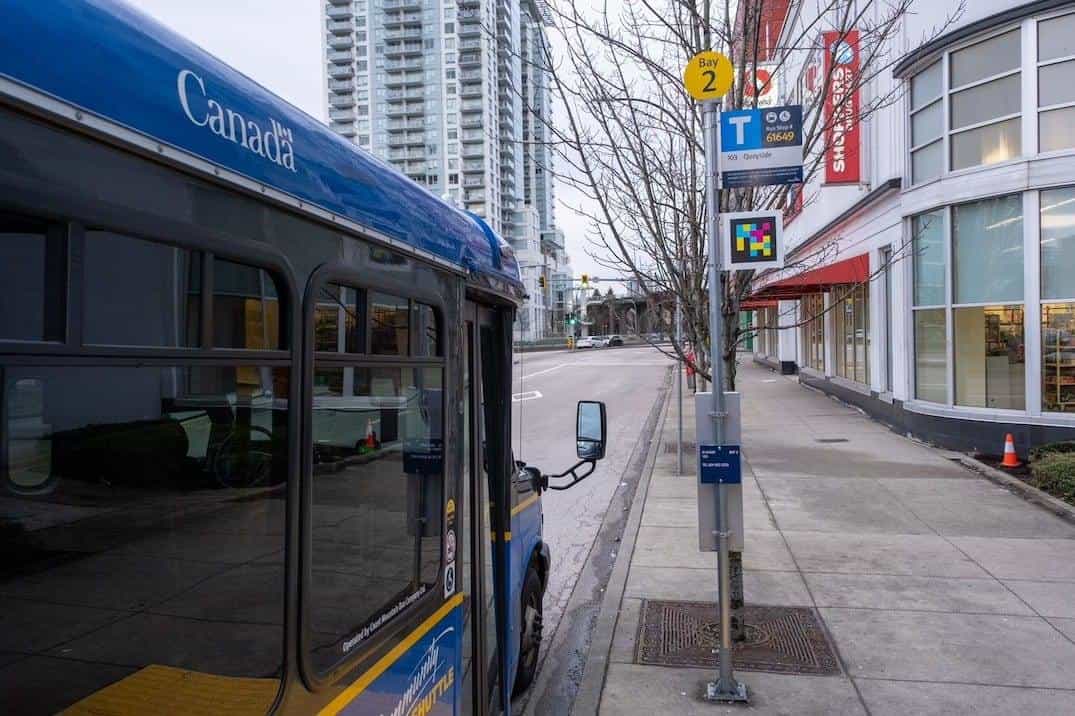
TransLink installed decals carrying NaviLens codes next to the existing stop signs. The user opens the app, sweeps the phone and, from up to 46 feet, hears the stop number, routes, direction and real-time alerts.
The codes don't need to be focused on, they work on the move and in any lighting. The app also identifies nearby amenities—elevators, SkyTrain access—and guides users to the exact boarding spot.
The pilot covered three contrasting settings: one covered transfer station (New Westminster SkyTrain) and two community environments (the CNIB office and the Vancouver Community College campus).
§ Three settings, one language
From the open street to the covered interchange.

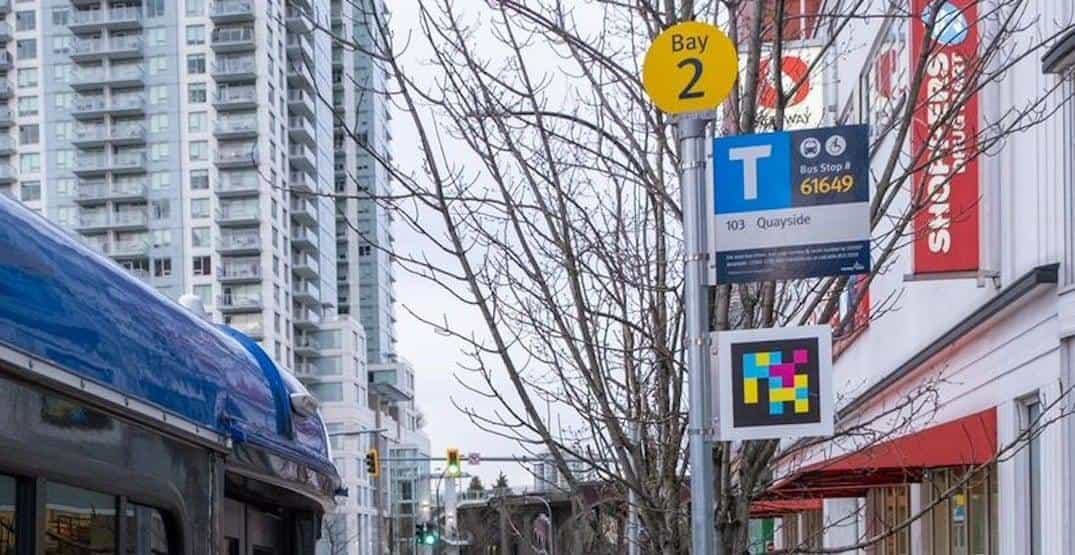
The 16 pilot codes break down as: 10 bays at New Westminster SkyTrain Station, 4 stops near the CNIB office in New Westminster and 2 stops by the VCC campus on East Broadway, Vancouver.
§ Why it matters
A small pilot with network-wide ambition.
First in Canada
TransLink is the first Canadian public-transport operator to deploy NaviLens, joining New York, Liverpool and Madrid.
A layer, not a patch
NaviLens lives alongside braille across all stops (~8,400) and tactile paving on TransLink property: each technology covers what the others can't.
Built to scale
The pilot was scoped at 6 months with a follow-up evaluation, designed to inform a possible expansion across the whole Metro Vancouver region.
Sources: TransLink — “TransLink launches Accessible Navigation Project” (9 Jan 2023); The Buzzer (TransLink) — “Moving towards a more accessible TransLink” (Jun 2023); CBC News — “TransLink to pilot coded decals at bus stops for blind riders”.
§ And your network?
Your next station can also speak.
Tell us about your network, your pain points and the KPIs you want to move. We’ll show you how NaviLens would fit—with comparable cases.